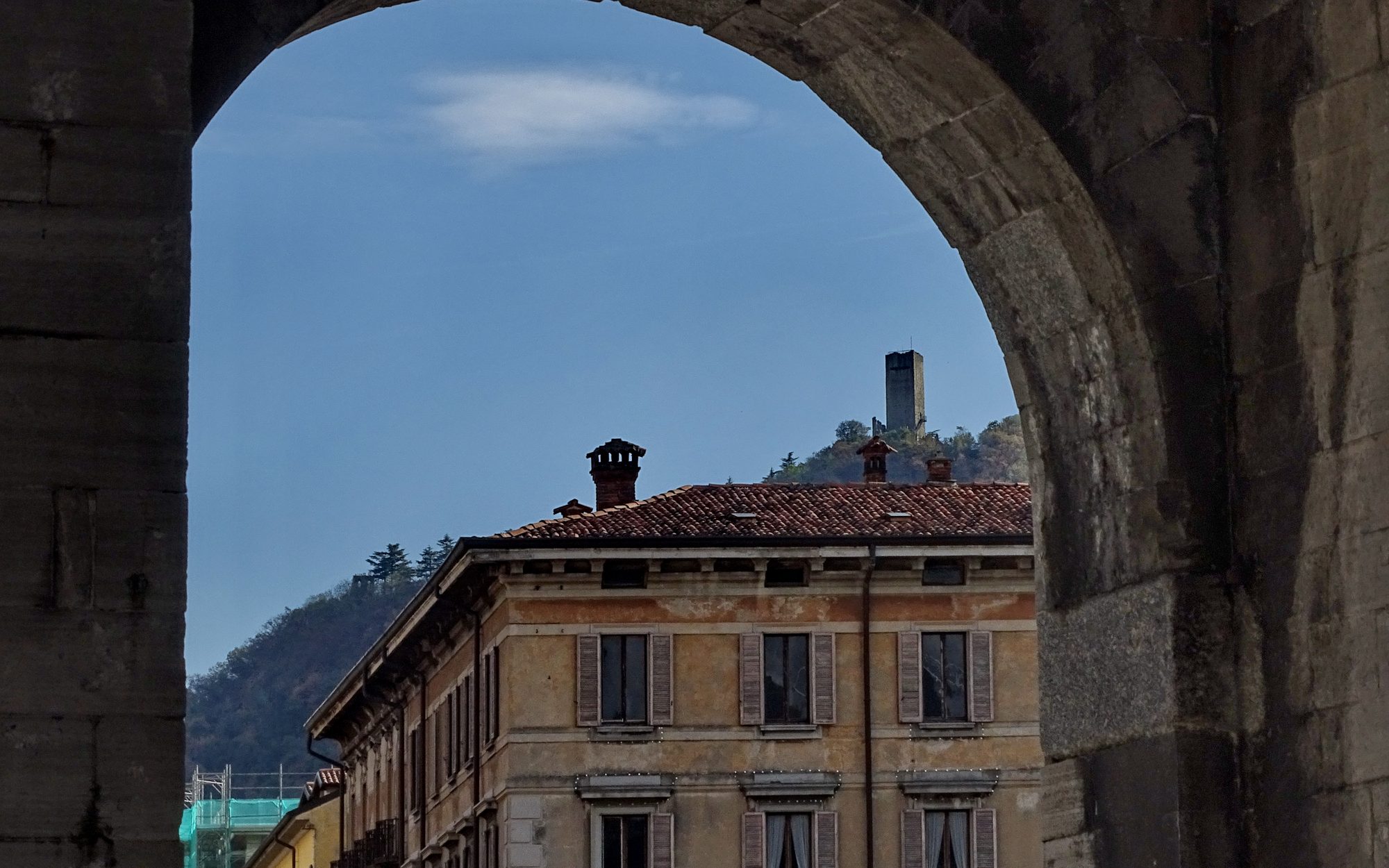
The basilica of San Carpoforo, at Camerlata at the foot of Baradello castle, is a church of the Como area: founded according to tradition at the end of the 4th century, it was rebuilt in Romanesque forms in the 11th century. It has a facade without a portal, set against the slope, and you enter by a door on the south side.
History
The basilica is dedicated to Carpophorus, martyred with some companions in the persecution of Maximian (303-304). According to tradition it was founded by Bishop Felix, Como’s first, who chose it as his burial place; it was built as a cemetery church just outside the town, in a strategic position along the road to Camerlata, where there was a large necropolis. A tombstone of 401, set into the wall along the crypt stairs, is the oldest Christian evidence in the Como area. According to the regional record, King Liutprand of the Lombards seems to have had it restored; Il Faggio sul Lago dates the work to 724.
Two things often read are rejected by the regional record: that it was the first cathedral, an error that arose from the presence of the bishop’s tomb (Como had two cathedral groups within the walls), and that it stood on a temple of Mercury, which it calls an antiquarian fantasy. UPEL, Wikipedia and Il Faggio instead report them as historical fact. In 1040 Bishop Litigerio is said to have installed a Benedictine monastery there: the regional record speaks of a women’s community and warns that a recent analysis of the documents considers them apocryphal, while for Monumenti Aperti it was a men’s one. The consecration is 1040 for Il Faggio and 1044 for Wikipedia.
In the 16th century the Hieronymite monks took over and the monastery went into commend, while the church served as a parish. In application of the rules of the Council of Trent the architect Giovanni Antonio Piotti da Vacallo covered the naves with vaults. With the suppression of 1773 the monastery was closed and the church kept functioning; a century later a large restoration redid the floors of the church and crypt. From 1871 Don Vincenzo Barelli began a restoration that, with pauses and resumptions, was completed only fifty years later with L. Perrone and Antonio Giussani: the 16th-century vaults were demolished, the trussed roof restored and the presbytery vault rebuilt. In the end the church lost the status of parish church, while the buildings of the former monastery, set against the basilica, passed to a religious order that opened a school there and still house a school today.
What to see
The facade, facing the Baradello, is closed against landslip-prone ground and has only three splayed single-light windows, now walled up; a document of 1204 speaks of a porch. For the regional record the lack of a portal depends on the landslip-prone ground, for Wikipedia also on the choice of orienting the building to the east. Outside, the apse has slender half-columns and a frieze of blind arches, and inside courses of alternating black and white stone. The bell tower, tall and of squared stone, recalls those of Sant’Abbondio. The whole building is of Moltrasio limestone.
The interior has three naves divided into five irregular bays, with rectangular pillars and a presbytery raised above the crypt, reached by two stone staircases. The crypt, in the form of an oratory, has three small naves with columns and corner-leaf capitals, similar to those of Lenno and the Isola Comacina, and suggests a date within the 11th century. Along the stairs are walled tombstones and part of a floor of black and white slabs, found in the 19th-century digs. In the church a Roman cippus, reused in the Romanesque period, bears a carved hunting scene: a hare, or perhaps a deer, chased by a dog. The frescoes are 16th- and 18th-century, and the chapel of the Assumption, in the left apse, is frescoed throughout according to Wikipedia. According to Wikipedia the Baroque high altar covers the ancient sarcophagus of Saint Felix, and in 1932 the parish moved to the new church of Santa Brigida, where the remains of the saint and of the first martyrs were taken.
Practical information
- The basilica is on via San Carpoforo, at Camerlata, at the foot of the Baradello.
- Access is by the side door, not through the facade.
- We found no official source for opening hours or visiting arrangements: it is best to ask the parish or the diocese.