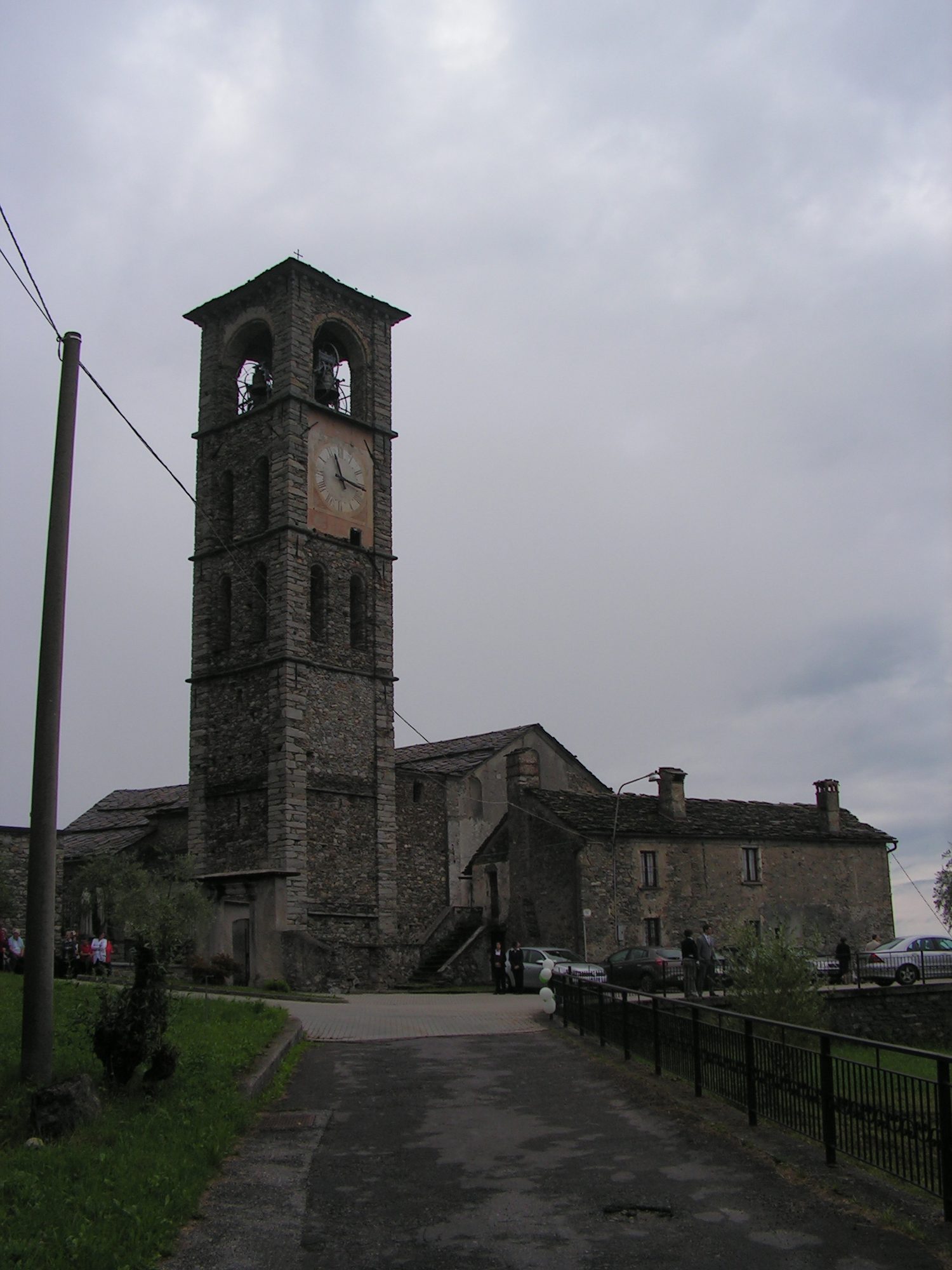
The church of Santi Eusebio e Vittore is the prepositural church of Peglio, on a rise at the foot of the Sasso Pelo, with a view reaching to Gravedona and the Upper Lario. It was rebuilt between 1607 and 1613 and soon frescoed by the Fiammenghino, and its walls also tell the story of the men of Peglio who emigrated to Palermo.
History
It originally depended on the pieve of Gravedona and in 1461 was raised to a parish church, then to a provostship. The late-Gothic building was demolished in the early 17th century and the regional record gives the dates 1607-1613 for the construction. The FAI website reports a legend about the site: the inhabitants wanted to build the church closer to the village, but the stones carried there vanished and were found the next morning where the church stands today, moved, it is said, by spirits.
When the rebuilding was done, the decoration was entrusted to Giovanni Mauro Della Rovere, called the Fiammenghino, a painter active mainly in Milan and known for the Sacri Monti, who worked there at various times from 1614 to 1623. An important part of the money and furnishings comes from emigration: between 1600 and about 1750 many men of Peglio went to Palermo as merchants, innkeepers, masons or goldsmiths, and most of the furnishings came from the emigrants who grew rich there. Wikipedia lists the signs of this link: in the chapel of Saint Joseph a canvas of the «Transit» which tradition says was sent from Palermo; the chapel of Saint Charles, commissioned by a certain Alberto Mangino in memory of the scola, the confraternity of the men of Peglio in Palermo; the chapel of Saint Rosalia, patron of Palermo, with frescoes attributed to Caracciolo of Vercana; a bell of 1681 donated by the Scola Panormi and cast by the Lorrainer Francesco Sottile.
What to see
The church is preceded by a very tall portico on four columns, where 16th-century frescoes remain that point to the school of Bernardino Luini. The interior is a single nave with six chapels, three on each side, each with its altar; the high altar, in gilded wood, is of 1635 according to Wikipedia. Above the main door is the organ built between 1608 and 1627 by Costanzo Antegnati of Brescia, kept almost entirely original: the records of 1612 describe it as «shining with gold and sweet in sound», and on the doors that close the case the Fiammenghino’s hand is recognised.
Much of the decorative scheme is the Fiammenghino’s. In the choir, the four Doctors of the Church are accompanied by scenes of the Last Judgment and images of Hell, and the contract that proves it is kept in the parish archive. The Judgment, very colourful, fills the left wall of the presbytery and stages heaven, earth, river and infernal city: above, Christ the judge, with the Madonna and the Baptist at his sides, and below, the resurrection of the dead, the archangel Michael leading the just and the damned plunging into the Acheron, towards the city of Dis. Opposite, a second large scene shows Hell with the punishments of the various sins, and at the edge is Purgatory as a furnace from which angels free the redeemed souls. In the vault appear the Pentecost, the Coronation of the Virgin and God the Father blessing; in the chapels of Saint Anthony and of Saint John the Baptist are other frescoes by him, and the latter has a self-portrait of the painter with the woman he loved; in the apse, Saint Eusebius at the Council of Milan before the emperor Constantius II.
By the Intelvi painter Alessandro Valdani are the frescoes on the pillars of the nave (1765) and the Triumph of Death in the chapel on the churchyard. According to Wikipedia the church also keeps a Madonna and Child of the Luini school and paintings attributed to Guercino, Giambattista Rodriguez, Giuseppe Antonio Petrini and Caracciolo of Vercana.
Getting there
From Gravedona a panoramic road of about three kilometres climbs to Peglio. The church stands at the edge of the village, near the cemetery. It is the place where the first day ends and the second begins of Via dei Monti Lariani, section 4.
Practical information
- Address: piazza della Chiesa 1 (Touring Club and diocese of Como); the FAI writes strada della Chiesa 4, the regional record piazzale Santi Eusebio e Vittore.
- The Touring Club gives opening every day from 3 to 6 pm, with no seasonal closures and free entry; the information is undated, and a visit blog, also undated, found the church closed. It is best to phone the parish of Santi Eusebio e Giacomo (0344 85261), which also includes churches in Livo.
Sources
- FAI, Chiesa di Sant’Eusebio e Vittore (Peglio)
- Lombardia Beni Culturali, Chiesa di S. Eusebio (record CO250-00628)
- Camminare nella storia, Peglio. Il Giudizio finale e un conturbante Inferno
- Touring Club Italiano, S. Eusebio (Peglio)
- Diocesi di Como, Parrocchia Santi Eusebio e Giacomo (Peglio)
- Esploratori della domenica, Esplorando l’Alto Lario (parte 2)
- Wikipedia, entry Chiesa dei Santi Eusebio e Vittore.