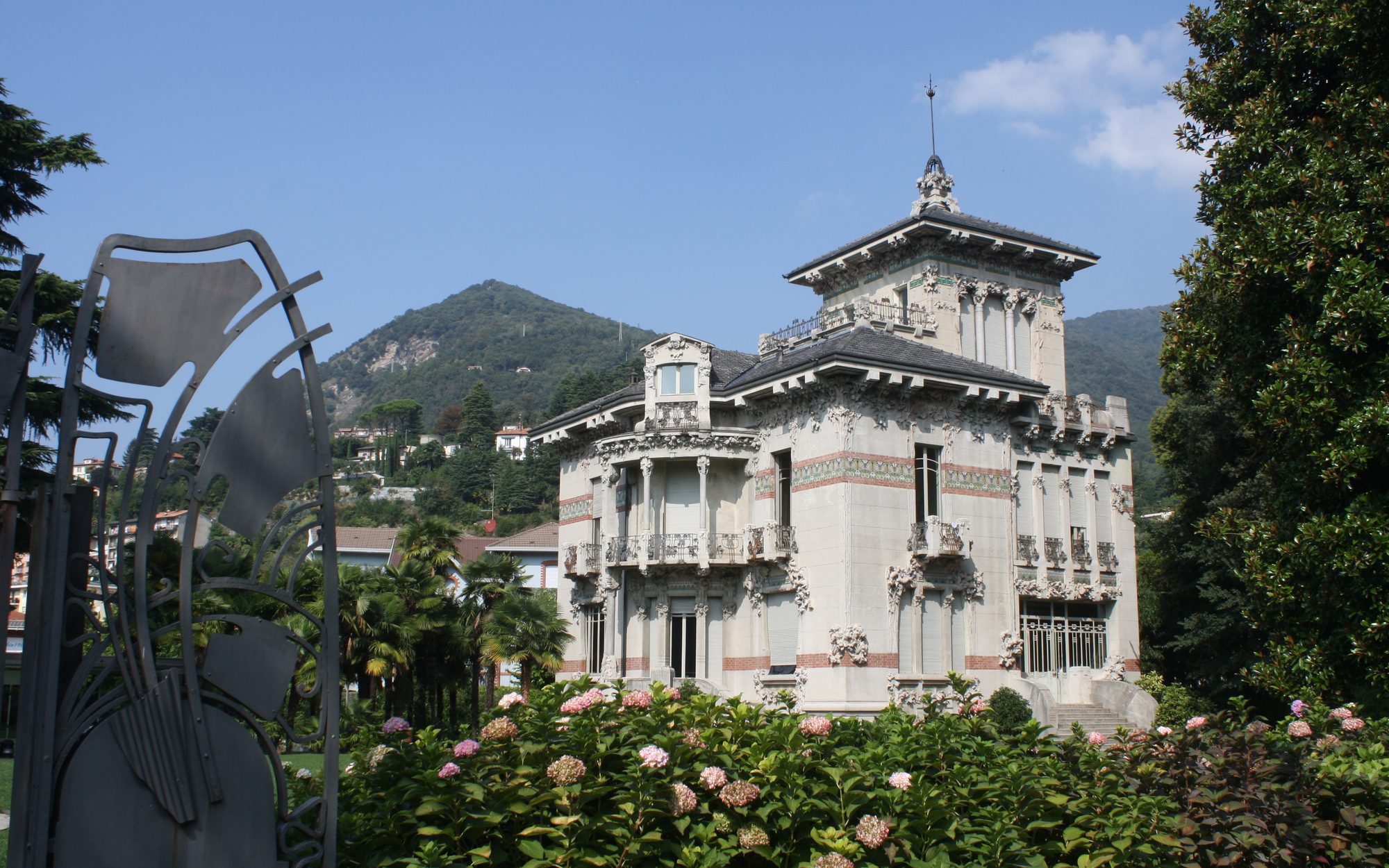
The «cittadella della seta» (silk citadel) is the quarter of Cernobbio that grew around the Tessiture Seriche Bernasconi: factory, offices, workers’ houses, kindergarten and the owner’s villa between via Aquileia, the Breggia stream and via Regina. What remains is the brick chimney, sheds with sawtooth roofs and some buildings that are still in production.
History
Davide Bernasconi started the Tessiture Seriche in Cernobbio in 1872 according to UPEL and Scripomuseum (Wikipedia writes 1876 and a weaving shop with forty looms). The factory began with sixty mechanical looms, among the first in Italy, and before the end of the nineteenth century reached six hundred looms and about a thousand workers. In 1899 the firm became a joint-stock company; the founder died in 1922 and the company stayed active until 1971.
For those working in the Bernasconi plants he had the homes of workers and managers built, in the San Giuseppe quarter, and the Asilo infantile Bernasconi, opened in 1881 for the workers’ children and still running. The quarter also held the owner’s residence, now the Town Hall, which in 1906 he left to his son while building Villa Bernasconi, and the Allamel dyeworks, taken over by Bernasconi and turned in the 1930s into public housing. After the closure some buildings stayed industrial; the former offices and warehouses now house the municipal library, the Spazio Giovani, the CNGEI scout association and the middle schools.
What to see
The walk crosses the streets of the quarter. Behind the Town Hall, beyond the car park, stands the tall terracotta chimney, the «caminun», the only reminder of the Bernasconi weaving mill that stood in that area. Next to it a small garden holds the «Luogo della Memoria», set up in the early 2000s: a circular space with benches, at the centre an iron work by the sculptor Riccardo Mantero for the victims of Nazi-Fascism, surrounded by eleven other pieces recalling people of the area or victims of terrorism.
In via Cinque Giornate you see the Asilo Bernasconi and the «Casone», the houses for workers that Bernasconi built in the early years of the twentieth century; the shed at the start of the street, coming in from via Regina, is another testimony (in-Lombardia). UPEL points out the sawtooth roofs. According to QuiComo, in a part of the former mills two companies still work, CEL and Apparecchiatura di Cernobbio, carrying on the textile tradition.
Practical information
- Where: via Aquileia, largo Luchino Visconti, via Cinque Giornate and via Regina, in a residential quarter: there are no hours or tickets.
- The plants that are still active are private and are looked at from the street.
- The sources disagree on uniqueness: Camminacittà and in-Lombardia speak of the only textile industrial archaeology site of the Como area, UPEL of one of the few industrial archaeology sites.
- It is the sixth stop of the itinerary Cernobbio on foot; Villa Bernasconi is a few steps away.