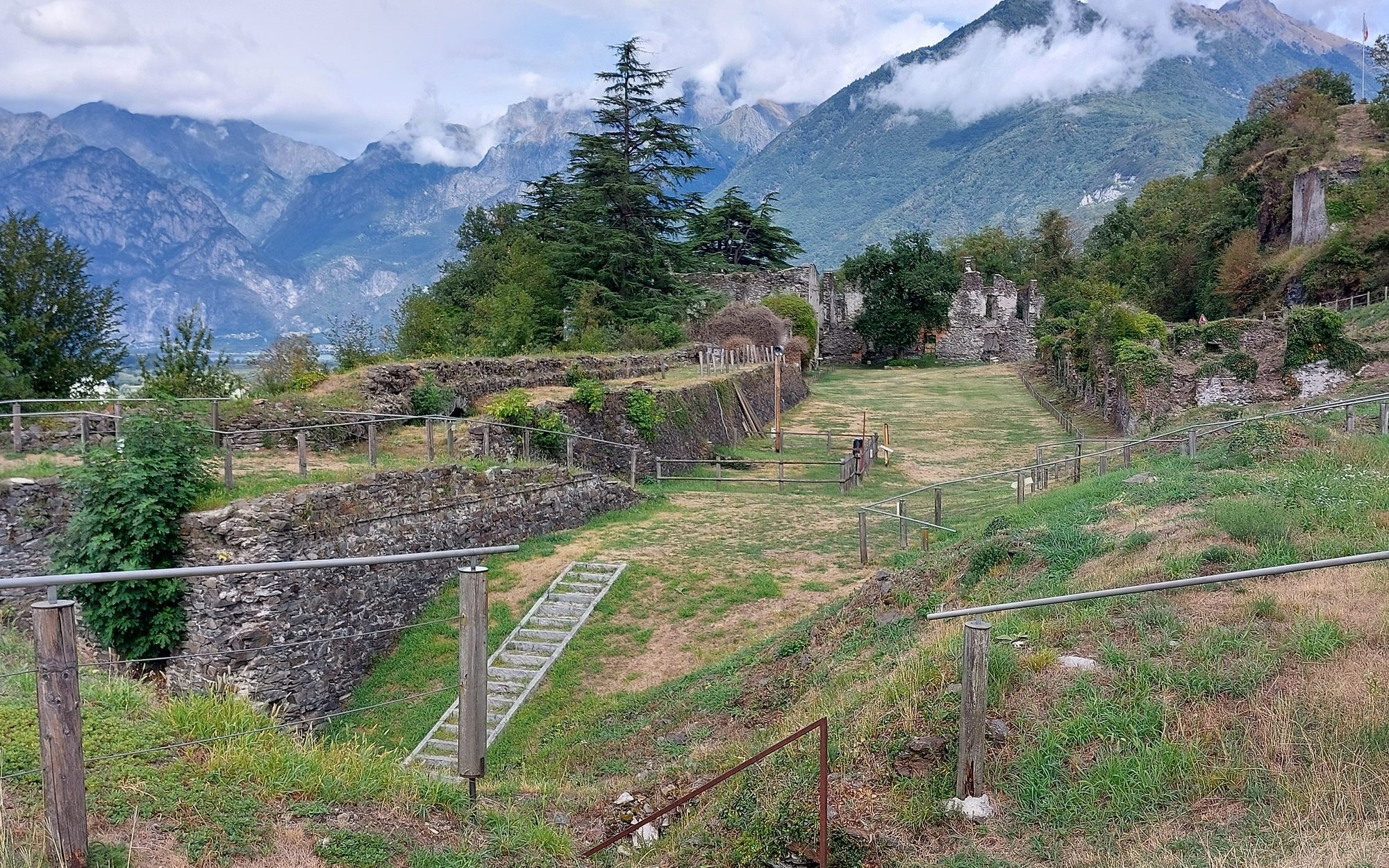
The Forte di Fuentes is the Spanish fortress seen on the Monteggiolo hill, a kilometre north of Colico, above the Pian di Spagna: after two centuries of neglect and Napoleonic demolition large ruins remain, open to paying visitors, of a work the Count of Fuentes wanted in 1603 against the Grisons.
History
On 24 October 1603 Pedro Enríquez de Acevedo, Count of Fuentes and Spanish governor of Milan, started work on the hill beside Monteggiolo, where the Valtellina and the Valchiavenna meet. The Valtellina was then in the hands of the Grisons, allies of France and Venice, who protested at the fortress without result. On the square made by levelling the top an Augustinian friar planted a wooden cross at the spot of the church, dedicated to Saint Barbara, patron of the artillery.
The work was huge: the top was levelled over an area of about 300 metres by 100-120, the stone was quarried on the spot, the lime kilns on the western shore were requisitioned and materials came by lake on the comballi. About two thousand workers laboured, day and night, under the military engineer Gabrio Brusca (Busca in the Wikipedia entry), with eight companies of soldiers on guard: the completion date varies, three years of work and an end towards the end of 1606 according to a local source, June 1604 according to Wikipedia. Inside were barracks, the governor’s palace, the church, a mill with oven, cisterns and underground stores. The fort worked as a system with the nearby towers, those of Sorico, Passo, Borgofrancone, Curcio and Fontanedo and the Adda fortlet.
In 1706, in the War of the Spanish Succession, the fort surrendered to the troops of Prince Eugene of Savoy (Wikipedia). Emperor Joseph II declared it useless, and in 1782 it was suppressed: the hill passed to private owners and the fort became a farmhouse. In July 1796 the French troops of General Rambeau demolished it, and between 1820 and 1859 the ruins sheltered bands of brigands. At the start of the 20th century the Italian army discarded it as a barrier across the Pian di Spagna, but kept it as an observation post and support for the artillery of the Montecchio Nord; during the Great War positions for heavy field artillery were built there and the round Spanish tower on the west side was pulled down. Today it belongs to the Province of Lecco, and is managed by the Museo della Guerra Bianca in Adamello, since 2011 according to the FAI, since 2012 according to Wikipedia.
What to see
The walls and the great gate to the south are clearly readable, with two round-arched openings under a barrel vault and white stone pilasters, reached by a stepped ramp. You can make out the vast parade ground, the traces of the barracks, the mill and the oven, and the church of Santa Barbara. The area measures about sixty thousand square metres, according to the FAI, and there is a guide and signage in French, English and German. From above you see the Pian di Spagna, now a nature reserve.
Practical information
- The fort is on the Monteggiolo hill, about a kilometre north of Colico; the two forts are linked by the Sentiero dei Forti, a loop of about 8.5 kilometres, see the Forte Montecchio Nord page.
- Fares (Visit Colico): full 8 euros, ages 6 to 17 4 euros, free up to age 5, for Colico residents and for Museum members; combined with the Montecchio Nord 15 euros (8 for young people). Groups by booking: 70 euros for up to 25 people, plus the ticket.
- 2026 hours according to Visit Colico (consulted on 4 October 2026): in October Thursday 1 and Friday 2 from 10am to 1pm, Saturday and Sunday from 10am to 5pm; in November Sunday 1 from 10am to 5pm, then Saturday and Sunday from 10am to 1pm (the page heads the month “November 2025”: probably a typo); from 26 to 30 December and from 1 to 6 January 2027 from 10am to 1pm. On other days you can visit by booking.
- Contacts: info@fortedifuentes.it, +39 0341 940322. The site fortedifuentes.it, at the time of consultation, did not open.
Sources
- Visit Colico, Fuentes Fort
- North Lake Como, Fort Fuentes (from the Colico Outdoor brochure)
- I Castelli, Forte di Fuentes and FAI, Forte di Fuentes
- Le Vie del Viandante, Colico - Forte di Fuentes
- Wikipedia, Forte di Fuentes entry.