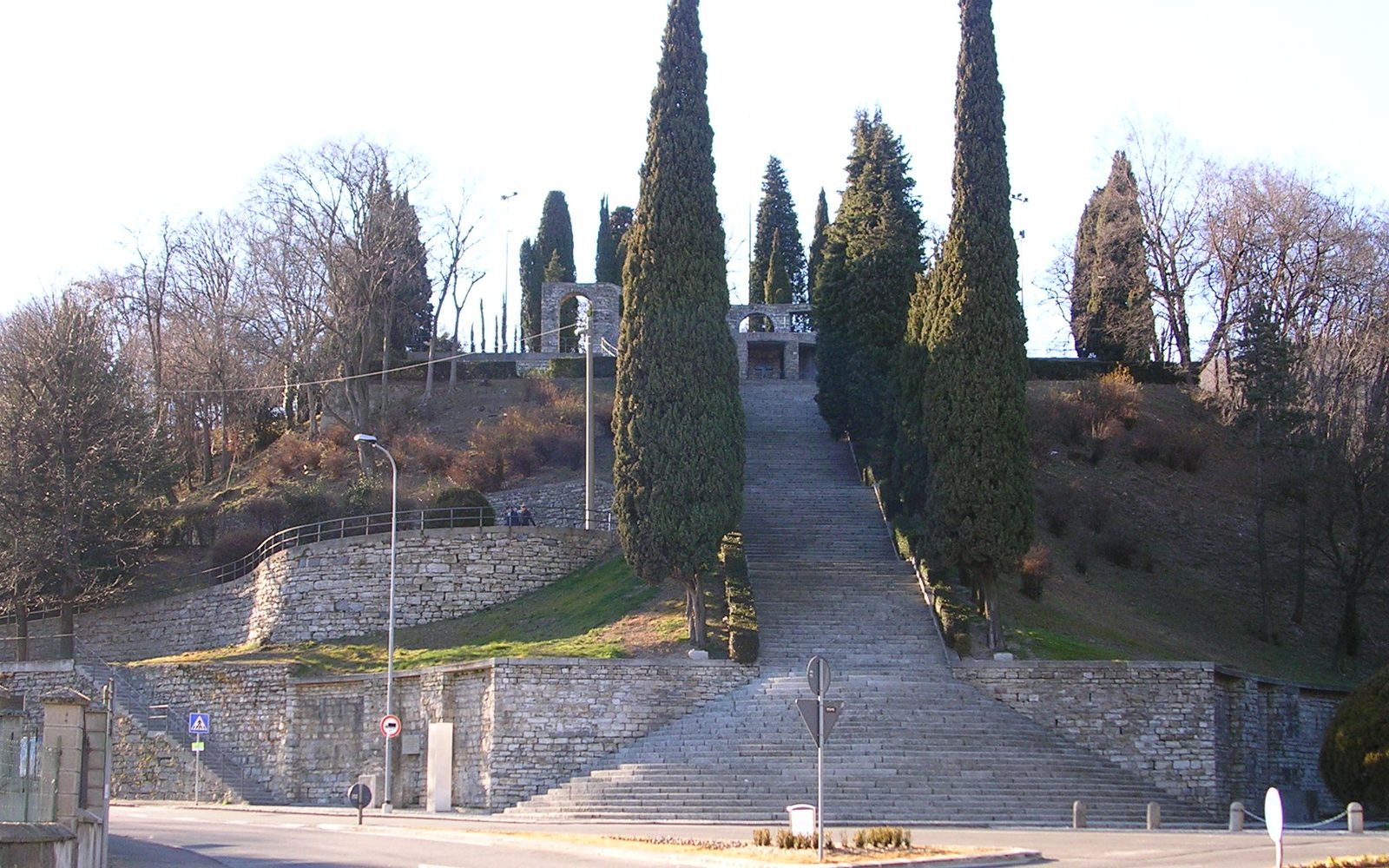
The Monumento ai Caduti of Erba is a long stone staircase that climbs between two rows of cypresses on the hill behind the centre, up to a shrine and a panoramic terrace. Giuseppe Terragni designed it in 1926 and a few days after its inauguration described it as «the first modern monument to the Fallen built in Italy». It is reached from below, at the start of corso Bartesaghi.
What it is
Terragni designed it for the fallen of the First World War. It stands on the slope known as «il Ronco dei Corti», and the staircase faces corso XXV Aprile, the town’s central street. It overcomes a height difference of about twenty-five metres with four straight flights of low steps, separated by three landings, with stone risers and cobbled treads.
At the top the staircase reaches a cylindrical volume, the shrine, with a crypt. On the curved cornice runs the inscription «Per quelli che furono, per quelli che sono, per quelli che saranno». Beside the altar are two mortars and a bomb. Two flights of stairs open out in a semicircle around the shrine and climb to the panoramic terrace, where a First World War cannon stands and where, at the back, a semicircular stone portico in the form of an exedra opens with architrave and arched portals.
A work without rhetoric
In the design the architecture is simple, without ornament, and the contrast is between the hardness of the stone and the green of the lawns and cypresses. Camminacittà, quoting scholars, reads in it the theme of ascent from below to above, in which the staircase links the life of the community, with its city space, and the place of remembrance, and reports that Terragni wanted a demanding climb, almost a sacrifice for those who came to pay homage. When it was built the monument created a new access to the nearby Teatro Licinium and became, the same source writes, a sort of completion of it; Terragni visited the theatre’s building site while working on the monument.
Originally the shrine held a bronze high-relief panel by Lucio Fontana depicting Victory. One night in 1936, little loved by the city authorities, it was removed on the order of the podestà, kept for a while in an attic of the town hall and then melted down for its bronze.
Dates and restoration
The sources do not agree on the year: Camminacittà and Gite in Lombardia say it was built between 1928 and 1931 and designed in 1926; for the Comune of Erba it was built in 1932; Chiesa di Milano writes 1928-1932. Camminacittà gives 29 May 1932 as the date of inauguration. A conservative restoration, designed and directed by Marco Ortalli with the Rotary Club Erba Laghi as promoter, was announced by Chiesa di Milano for the inauguration of 2 July 2015, together with an exhibition in the nearby Villa Candiani.
On the route
The monument is a stop on the Camminacittà route of Erba (third stage, from piazza Prepositurale to via Crotto Rosa). The full walk is in the Erba on foot itinerary.
Practical information
- The foot of the staircase is at the start of corso Bartesaghi. Camminacittà notes the architectural barriers: a large, rather steep staircase.
- The shrine and the terrace can also be reached from the entrances of the Teatro Licinium in via Crotto Rosa, which are normally closed.
- There is parking nearby, and in corso Bartesaghi there is a stop for the C40 bus Como-Erba-Lecco (Camminacittà, undated page).
- We have not found official opening hours for the shrine.
Sources
- Camminacittà, sheet Monumento ai Caduti di Erba (path 1, stage 3)
- Comune di Erba, Monumento ai caduti del Terragni
- Gite in Lombardia, Monumento ai caduti di Erba
- Chiesa di Milano, Il Monumento ai Caduti di Terragni: restauro di un capolavoro senza retorica (2015 announcement)
- Camminacittà, Erba path 1, stage 3
- OpenStreetMap, for the position.