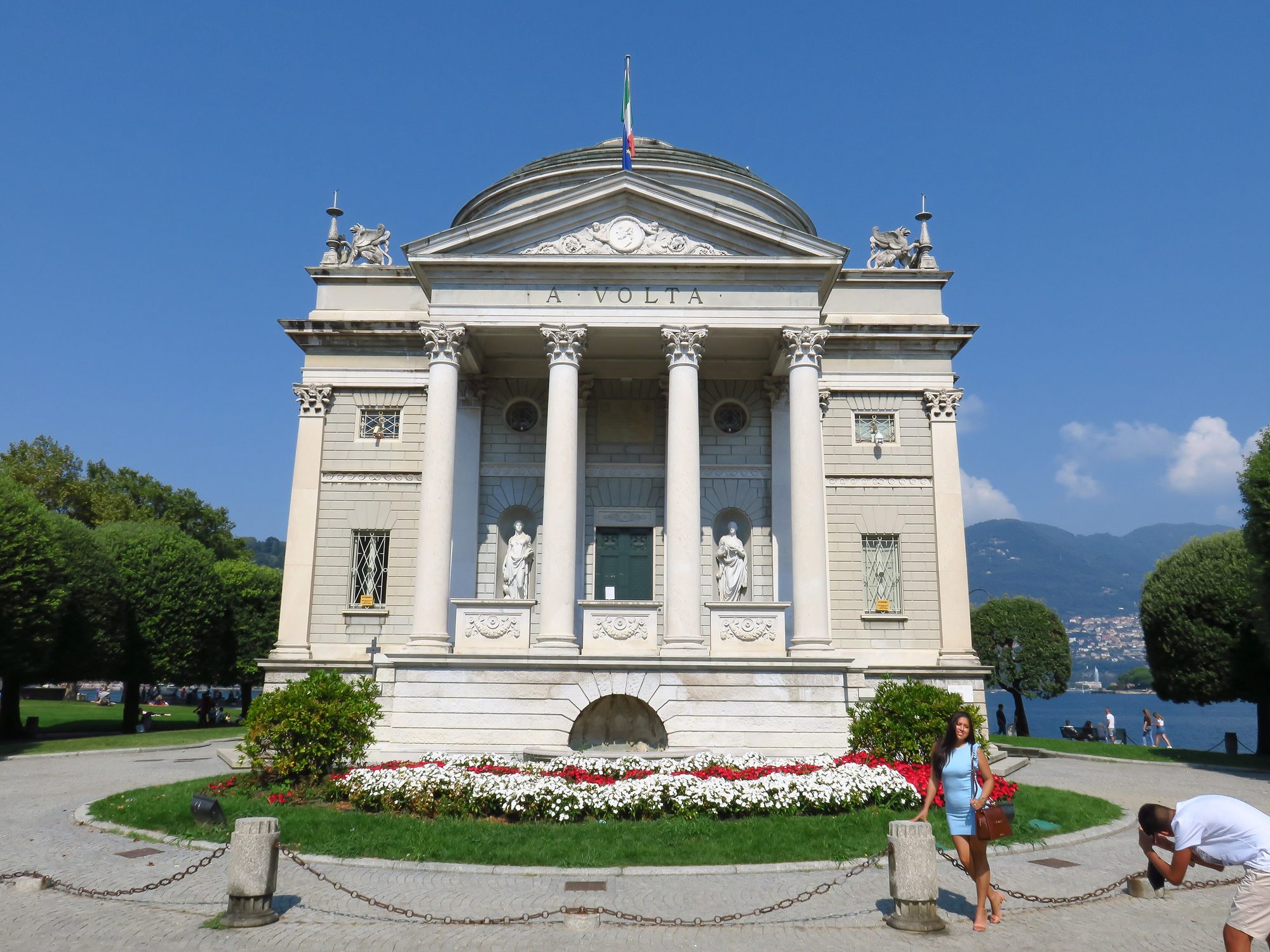
Opened on 16 July 1928 on the lakefront of Como, the Tempio Voltiano is a neoclassical building inspired by the Pantheon in Rome, built to house Alessandro Volta’s original scientific instruments.
The project followed a 1899 fire that destroyed an earlier temporary exhibition dedicated to Volta, causing the loss of original instruments. Construction of the current temple, funded by the cotton industrialist and senator Francesco Somaini as a gift to the city of Como, was entrusted to architect Federico Frigerio: work began in 1925 and the building was completed in 1927, to be inaugurated the following year on the centenary of the Como-born scientist’s death (1827-1927).
Architecture
The neoclassical building has a square base roughly 26 metres wide, topped by a large circular hall covered by a dome, for a total height of about 26 metres; the interior, inspired by the Pantheon, is around 12 metres in diameter and includes an upper gallery. The reinforced-concrete structure is clad in Karst stone.
Collection
The museum holds Volta’s surviving scientific instruments, including several versions of his voltaic pile, capacitors, Leyden jars, electrometers and equipment for the study of gases. The upper gallery displays his personal effects, honours and decorations, including medals awarded by rulers such as Napoleon Bonaparte.
Practical information
- Open Tuesday to Sunday, 10:00-18:00 (last entry 17:30); closed Mondays, with scheduled exceptions (e.g. Easter Monday and the feast of Sant’Abbondio).
- Paid admission, tickets available on site or online (museicomo.vivaticket.it); residents of the Comune and Province of Como can get the CoMmUnity card for unlimited yearly access to several civic museum venues.
- Part of the Como Civic Museums network together with the Museo Archeologico Paolo Giovio, the Museo storico Giuseppe Garibaldi and the Pinacoteca civica, with combined-ticket options.
- Address: Lungo Lario Marconi, Como (lakefront, near the Giardini a Lago).