On 5 March 2027 it will be 200 years since the death of Alessandro Volta, born in Como in 1745, and the city began its celebrations on 5 March 2026. This itinerary follows his traces on foot through the centre, from the birthplace to the Tempio Voltiano, along the «Il cammino dell’invenzione» route by Camminacittà (page updated in March 2026), and adds the tomb at Camnago Volta. The stops are places in a life: where he was born, where he did his first experiments, where he was baptised and where the city remembered him.
The walk in brief
The Camminacittà project proposes three stages in three different areas: the centre of Como, the Cosia valley as far as Camnago Volta, and Brunate. Here you walk the first, from via Volta 62 to the Tempio Voltiano: about 3 kilometres and 45 minutes, visits excluded, with no climbs, on an urban route at a maximum altitude of 200 metres. The tomb, at Camnago Volta, is a separate stop.
| Place | How it is seen (October 2026) |
|---|---|
| Alessandro Volta’s house | Private palace: seen from the street |
| Torre Gattoni | Seen from outside; the interior is not normally accessible |
| Church of San Donnino | Almost always closed |
| Monument to Alessandro Volta | Always visible, in the square |
| The Life Electric | Always visible, on the breakwater |
| Tempio Voltiano | Museum: Tuesday to Sunday 10-18, with a ticket |
| Tomb at Camnago Volta | Cemetery, free entry, 8 to 17 or 17.30 |
From the birthplace to the Torre Gattoni
You start at via Volta 62, in the old contrada of Porta Nuova, in front of Alessandro Volta’s house: a severe neoclassical palace where the physicist was born and died, with a plaque to the right of the main door. You take via dell’Annunciata, leave the walled city where the gate of the same name stood and enter the gardens that run along viale Varese and the Federician walls, so called after Frederick Barbarossa.
At the end of the gardens, at a corner of the walls, stands the pentagonal Torre Gattoni. It was the tower of Canon Giulio Cesare Gattoni, a friend of Volta, who set up his physics laboratory, an observatory and a museum there. Volta had used Gattoni’s laboratory since 1765, even before it was in this tower. From here, in under 300 metres, you reach Porta Torre, the medieval tower of 1192 that for centuries was the entrance to Como from the south.
The Liceo, San Donnino and the Jesuit college
Back in the walled city, in via Cantù the portico with eight cipollino marble columns, from the ancient baptistery of San Giovanni in Atrio, leads to the Liceo «Alessandro Volta», which has carried his name since 1865. In the Real Ginnasio, housed in the former Jesuit college, Volta taught experimental physics from 1775 to 1778, before leaving for the University of Pavia; the school keeps a collection of scientific instruments of the period, including those donated by Gattoni.
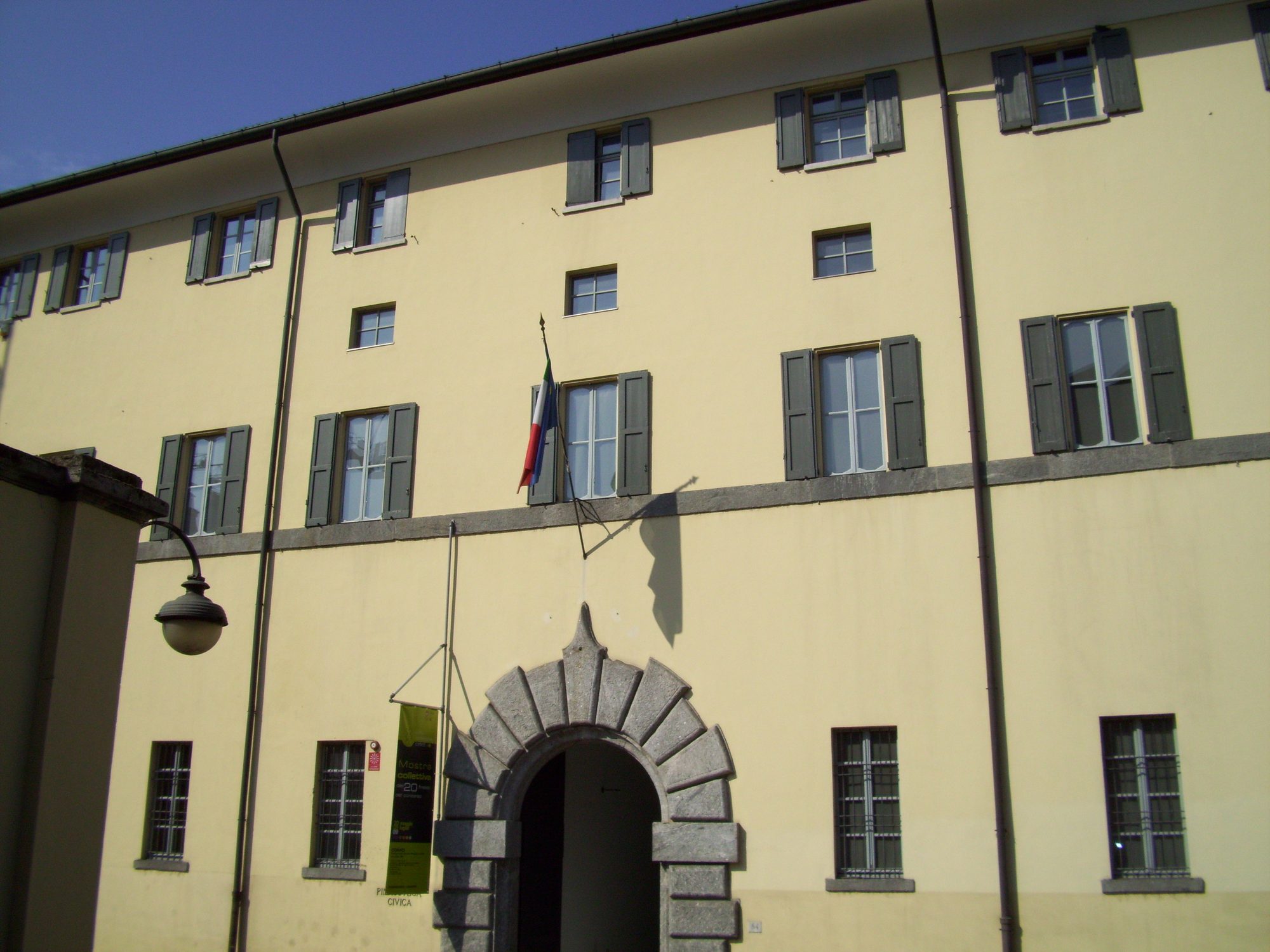
You continue along via Diaz, to the church of San Donnino, where Volta was baptised the day after his birth, taught catechism and, on 7 March 1827, had his funeral. Opposite is Palazzo Volpi with the Pinacoteca civica. Further on, in the church of the Gesù and the former college, Volta studied from the age of thirteen (Oggi a Como).
Piazza Volta and the Hall of Nobel Laureates
Through the streets of the old town, among them via Vitani and the demolished Cortesella district, you reach piazza Volta, where in 1838 the monument to Alessandro Volta was inaugurated: the scientist beside the pile, by Pompeo Marchesi, on a base by Francesco Durelli.
Then you follow viale Cavallotti, where the Istituto Carducci complex holds the Museo delle Scienze Casartelli, in the «Sala dei Nobel». Here, in September 1927, for the centenary of Volta’s death, the International Congress of Physicists met, with twelve Nobel laureates. The sources on visits do not agree: the Comune writes, on a page updated on 18 October 2024, that ordinary management is suspended and that it is visited by groups on request; Camminacittà, in 2026, says it is visited independently by appointment with the secretariat of the Associazione Carducci (+39 031 267365, Monday to Friday 9 am to 3 pm).
The lakefront: The Life Electric and the Tempio Voltiano
From the lakeside gardens, where in 1899 the great Voltian Exhibition was held, you walk along the breakwater, about 350 metres long and finished in 1868, to The Life Electric, Daniel Libeskind’s 2015 monument to Volta; the breakwater ends there and you go back the way you came.
Back on the shore, a few steps away on the lakefront, is the Tempio Voltiano, designed by Federico Frigerio and completed in 1927 for the celebrations of the centenary of his death. It houses originals and reconstructions of Volta’s scientific instruments, destroyed by the fire of 1899 during the Voltian Exhibition, and documents on Volta the citizen.
Outside the centre: Camnago Volta and Brunate
Camminacittà’s second stage follows the Cosia valley, for about 3.7 kilometres and an hour and ten minutes, from via Pannilani to Camnago Volta. Here is Alessandro Volta’s tomb, a neoclassical little temple of 1831 in the old cemetery, which the Comune di Como honoured on 5 March 2026 for the anniversary of his death, and the country house at Campora, where Volta spent the summer. Camminacittà also recalls the Mulino Beretta, an old water mill that worked until 1983 and is visited by contacting the owning family.
The third stage, about 1.9 kilometres and an hour, climbs to Brunate, where Volta spent the first years of his life with a wet nurse, as far as the Faro Voltiano. In 2026 the lighthouse is closed to the public: see its page for the state of the works. You reach Brunate by the Como-Brunate funicular.
The 2026-2027 bicentenary
The local celebrations, promoted by the Comune, the Chamber of Commerce, the Province, the University of Insubria, Confindustria Como and the Fondazione Alessandro Volta, began on 5 March 2026 at the mausoleum of Camnago Volta and at the Tempio Voltiano. They run over two years, with main stages in March and September 2026 and in March and September 2027. The Teatro Sociale has dedicated its 2026-2027 season to Volta, and among the planned initiatives are works at the Tempio Voltiano and a lighting project on the lake (CiaoComo, 6 March 2026). For dates it is best to check the channels of the Fondazione Alessandro Volta and of the Comune.
Practical information
- Lengths and times are Camminacittà’s: stage 1 about 3 kilometres and 45 minutes on foot, visits excluded; stage 2 3.7 kilometres and 1 hour 10; stage 3 1.88 kilometres and an hour, with a maximum altitude of 905 metres at the Faro Voltiano.
- Start at via Volta 62 (city buses and parking in viale Varese); finish at the Tempio Voltiano, near Trenord’s Como Lago station, in largo Leopardi, and the boat landing.
- The market area around viale Varese and viale Cattaneo is occupied by stalls on Tuesday, Thursday and Saturday.
- Volta’s house and the Torre Gattoni are not normally visited; San Donnino is almost always closed; the Museo Casartelli has conflicting rules (see above). The Tempio Voltiano and the tomb have their own hours, given on their pages.
- For getting to Como see the guide Getting to Lake Como.
Sources
- Camminacittà, Como Percorso 6: Il cammino dell’invenzione, with stage 1, stage 2 and stage 3 and the points of interest
- Oggi a Como, Itinerari voltiani a Como, I luoghi voltiani and Vita di Alessandro Volta
- Comune di Como, Museo delle Scienze Casartelli (page updated 18/10/2024)
- UPEL Italia, Luoghi comaschi di Alessandro Volta
- CiaoComo, Como, presentato il percorso verso il bicentenario della morte di Alessandro Volta (6 March 2026)