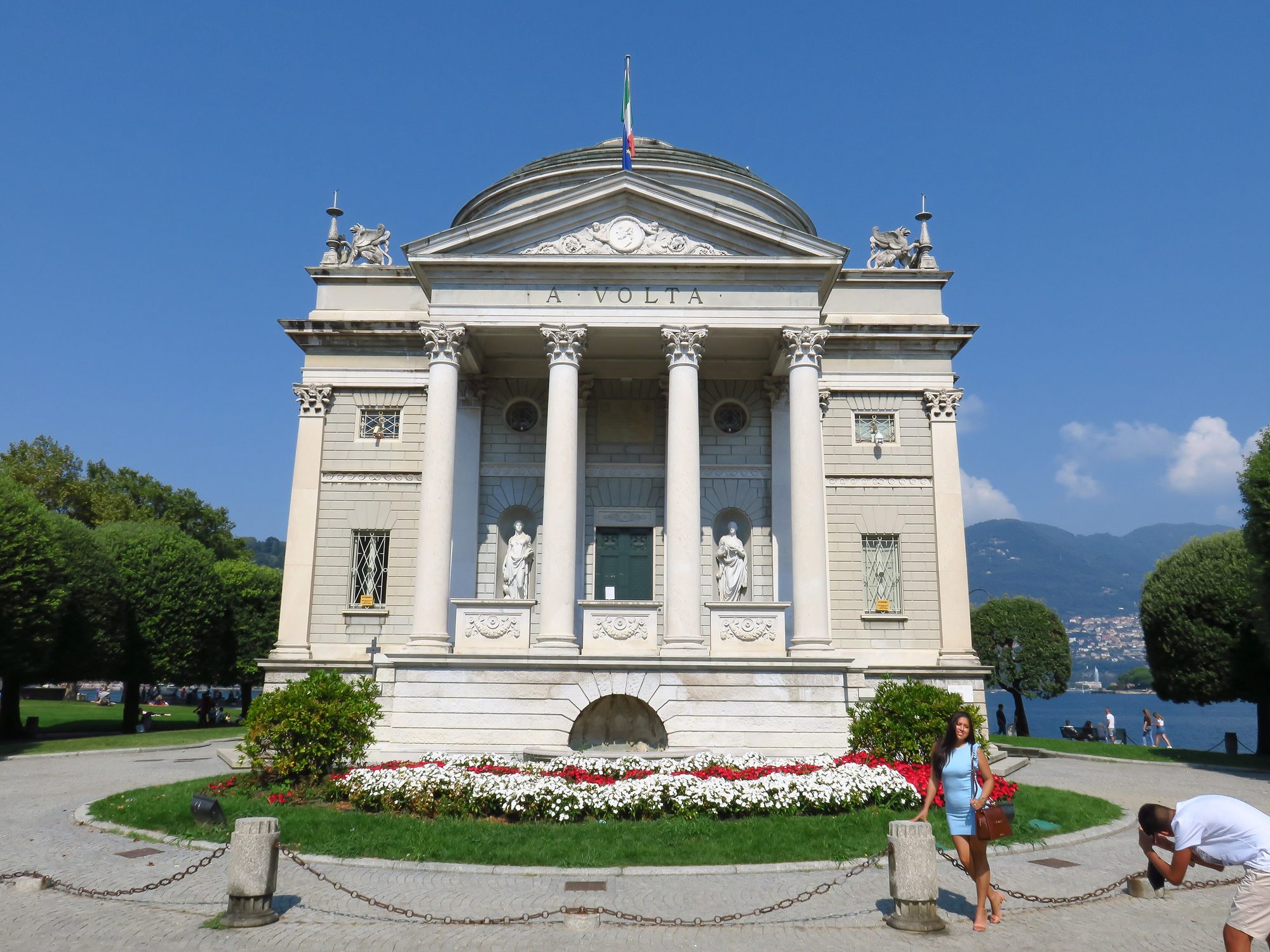
Alessandro Volta’s tomb is a neoclassical little temple in the middle of the old cemetery of Camnago Volta, a district of Como. It was commissioned by his wife and sons, designed by Melchiorre Nosetti and inaugurated on 5 March 1831; it has been a national monument since 1925.
History
Volta died on 5 March 1827 and, as he had asked, was buried in a simple grave in the first cemetery of Camnago, then an autonomous municipality, under a wooden cross: he was tied to that village by the house at Campora, where he spent the summer. His wife and sons wanted something more worthy for him and commissioned the little temple, inaugurated on 5 March 1831, exactly four years after his death. The Comune moved the cemetery around the monument, and some relatives also rest in the temple (Camminacittà). In his honour the village added the scientist’s name to its own: Camnago Volta, in 1862 or 1863 depending on the source.
The Volta portal recalls that in 1875 the body was exhumed at the request of Cesare Lombroso, who wanted to study the skull for his controversial research. A royal decree of 27 February 1925 declared the little temple a national monument. The 1999 restorations, the year of the bicentenary of the pile, went together with two period lamps fuelled by methane at the cemetery entrance, in memory of the marsh gas Volta discovered in 1776.
What to see
The little temple has the shape of a small pantheon: a cylinder of block stone, closed by a metal dome with a skylight, rising on a round terrace with three curved steps. In front of the entrance, under the inscription «Ad Alessandro Volta, la vedova e i figli» (to Alessandro Volta, his widow and sons), two sandstone statues carved by Luigi Argenti represent Faith in prayer and Science in tears. A marble frieze runs above, with triumphal crowns and symbols of Volta’s inventions.
Inside, a niche holds the sarcophagus by Giuseppe Bayer. Above it are the physicist’s bust, carved by Giovan Battista Comolli, and two winged geniuses, one of whom is about to crown him; higher up a relief shows Volta presenting the pile to Napoleon, in Paris in 1801, the most famous episode of his life. At the foot of the steps are two bronze plaques, one from the English electrical students (1903), one from Catholic students (1899).
Practical information
- Address: via Luigi Clerici, at Camnago Volta, in the old cemetery. You climb 6 steps to the cemetery and 3 more to the temple.
- Oggi a Como, the Comune’s portal, gives hours from 1 April to 30 September from 8 am to 5.30 pm and from 1 October to 31 March from 8 am to 5 pm, with free entry. Camminacittà instead refers to the Comune’s cemeteries page for hours, and we did not find them there: it is best to check before going.
- From Como you arrive by a city bus; for cars there is room outside the new cemetery, about 80 metres beyond the old one coming from the centre (Camminacittà).
- On 5 March 2026, the anniversary of his death, the Comune di Como paid homage here at the start of the road to the bicentenary (CiaoComo).
- It is the last stop of the itinerary Volta’s Como, outside the centre.