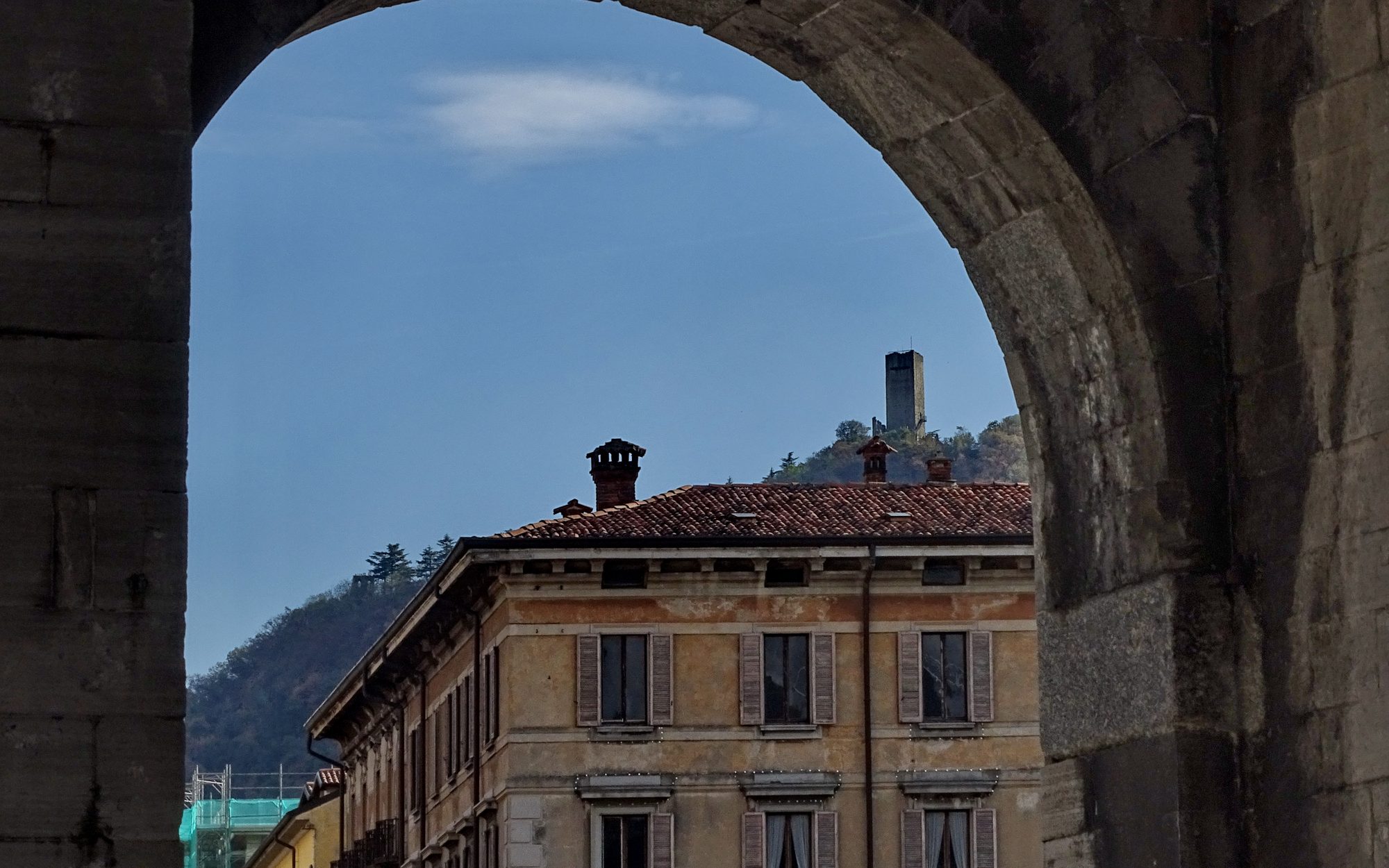
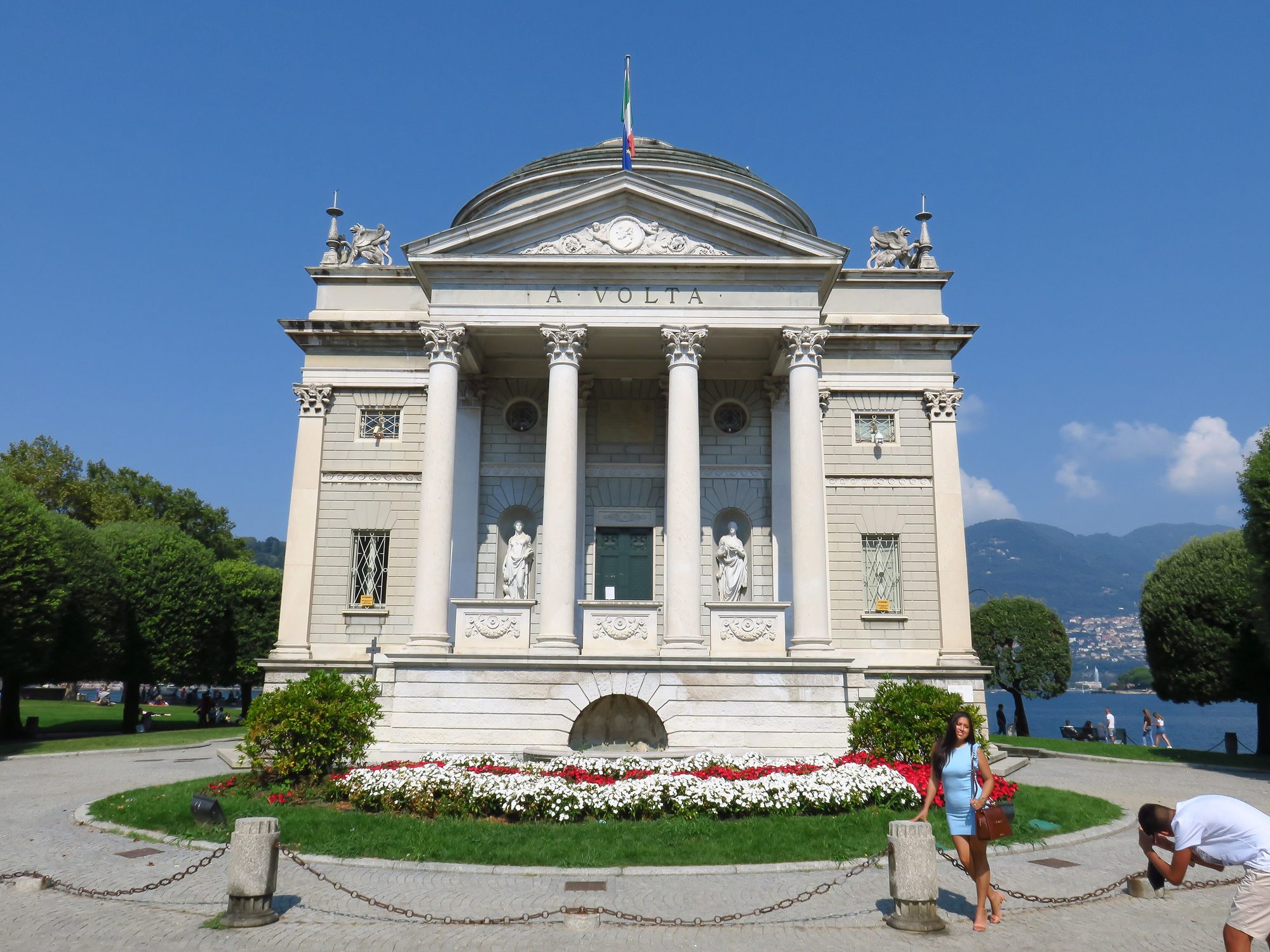
The Torre Gattoni, or Torre di Porta Nuova, is one of the three great medieval towers on the south side of the walls of Como, at the corner of viale Varese and viale Cattaneo. It takes its name from Canon Giulio Cesare Gattoni, who set up a physics laboratory, a meteorological observatory and a museum there, and was a friend of Alessandro Volta.
History
Como’s walls, pulled down by the Milanese at the end of the Ten Years’ War (1118-1127), were rebuilt in the twelfth century with the consent of Frederick Barbarossa. Porta Torre, in the middle of the south side, dates from 1192; the two pentagonal towers at its sides, Porta Nuova to the west and San Vitale to the east, are fourteenth-century according to UPEL. The sources disagree on the period: the Lombardia Beni Culturali entry says it came after Porta Torre in one place and was Federician in another, and the Wikipedia entry on Porta Torre ties it to 1192. The Porta Nuova tower has a pentagonal plan, like San Vitale, and according to Camminacittà a slight lean, perhaps already present during its construction.
Giulio Cesare Gattoni (1741-1809) knew Volta, four years younger, from boyhood, first as a neighbour and then as a fellow student with the Jesuits. In the laboratory he had at home the two carried out experiments on electricity, gases and meteorology: Oggi a Como writes that from 1765 Volta used it for many years. In 1768 Gattoni put a Franklin-style lightning rod on the roof of his house, probably the first in Italy. Around 1784 he obtained the use of the tower from the Comune and moved there the laboratory, the lightning rod, a meteorological observatory and a museum of stuffed animals, shells, minerals, weapons and archaeological finds, visited by scholars such as Saussure. With bells connected to the lightning rod they followed the electric charges of the air and predicted storms (ComoZero and the Volta portal).
The sources disagree on one point: Oggi a Como and ComoZero place Volta’s first experiments in the tower’s physics cabinet, around 1765, but the tower passed to Gattoni around 1784, and the laboratory of those years was in his friend’s house. In the early nineteenth century Gattoni opened the tower to the teachers and students of the new Liceo and, before dying, donated his instruments to the same school, which in 1865 took Volta’s name. In the 1930s the tower became the first electrical substation for the lighting of the walled city and remained so until 1958.
What to see
The tower stands in a green strip between viale Varese and viale Cattaneo, next to the area where the market is held on Tuesday, Thursday and Saturday. You see a large stone prism with a pentagonal plan and arrow slits. A small door at ground level gave access to the substation, of which the panel with its measuring instruments, the disconnectors and the «basculla» transformers are preserved.
Practical information
- Address: viale Varese at the corner with viale Cattaneo.
- Oggi a Como writes that the interior is not accessible. For Camminacittà the tower belongs to the Comune and opens only on particular occasions; for ComoZero it is now private property and closed except on rare occasions; the Volta portal says the first floor, now empty, is reached from the neighbouring Palazzo Mantero, at via Volta 74. La Provincia di Como (2025) calls it partly private. The sources disagree on ownership and access: to know whether there are openings, call the Info Point (+39 031 304137).
- State: a Svolta Civica motion of 11 September 2026 (EspansioneTv, ComoZero) recalls that the tower, like Porta Torre and the Torre di San Vitale, is surrounded by fences for fear of falling stones.
- It is a stop of the itinerary Medieval Como and the second of the itinerary Volta’s Como; after the tower you reach Porta Torre in about 280 metres, according to Camminacittà.
Sources
- Camminacittà, Como Percorso 6, Torre Gattoni record
- Oggi a Como, Torre Gattoni and Vita di Alessandro Volta
- The Volta portal, Gattoni Tower
- ComoZero, the centuries-old tower in the heart of Como where Volta did his first experiments
- Lombardia Beni Culturali, Mura medioevali di Como and UPEL Italia, Mura medievali
- La Provincia di Como, «Anche a Porta Torre transenne da tre anni» (3/4/2025)
- EspansioneTv, Mura e torri di Como, mozione di Svolta Civica (11/9/2026)
- Wikipedia, entries Torre di Porta Nuova (Como) and Porta Torre (Como).