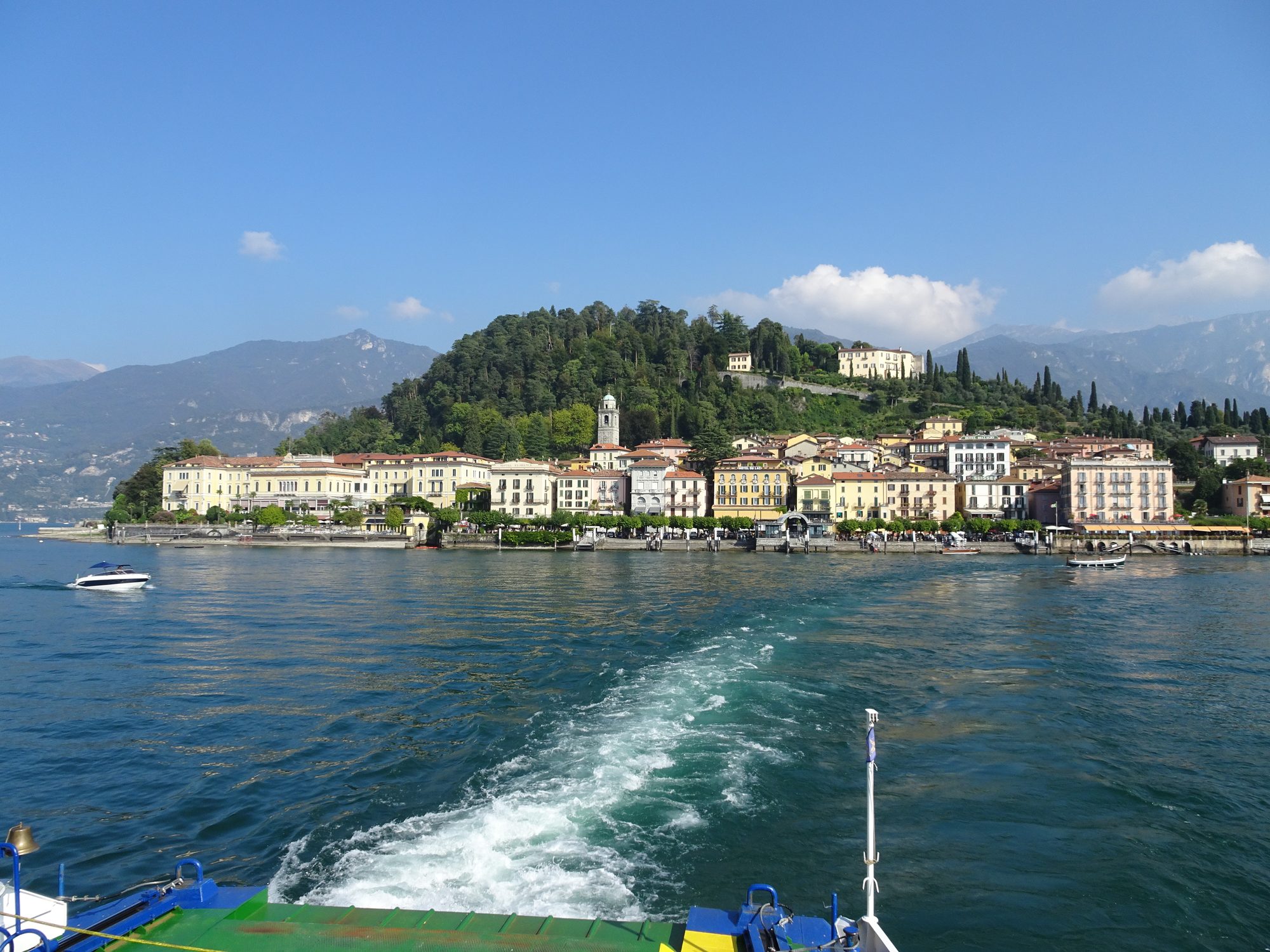
The basilica of San Giacomo is the church of the Borgo of Bellagio, on piazza della Chiesa: a Romanesque building with three naves and three apses, built between the 11th and 12th centuries, returned to its Romanesque form by an early 20th-century restoration and declared a national monument.
History
The sources do not fully agree on when it was built. The FAI gives the years between 1075 and 1125, Como e il suo Lago speaks of the 11th-12th century and of Comacine masters, Le Vie del Viandante of the 12th century, Il Borghista of the early 1100s. The bell tower rests on a tower of the medieval walls, adapted as a campanile when the church was built: the upper part was added later, in the 16th century for the FAI, in the 17th for Como e il suo Lago and Il Borghista, in the 18th for the parish website. The last major restoration of the tower dates from 1990.
On 23 February 1657 the church was raised to a prepositural parish, with territory detached from that of San Giovanni; according to the diocesan historical archive, in 1788 the patronage belonged to the Sfondrati house. In the Baroque period, around the middle of the 17th century according to Como e il suo Lago, the building was heavily altered. In the early 20th century the community, led by the provost don Maraffio, undertook a radical restoration: the Baroque additions were removed and what was missing was rebuilt in a style close to the original. Le Vie del Viandante dates the works to 1904, the year in which, per Il Borghista, the church was declared a national monument. According to the parish website only a few elements remain authentic (the sculptures of the ambo, the columns of the nave, the heart of the 15th-century Madonna delle Grazie fresco); the rest is a rather free 20th-century reconstruction.
What to see
Outside, the facade stands out, with stepped gables in grey stone, partly hidden by the bell tower, which rises on the left. Of the three apses, decorated with hanging arches with a double ring, the FAI stresses that they keep their original proportions. Inside, the rectangular plan has three naves with round arches and columns of Moltrasio stone, with capitals and bases in granitone.
Among the works, the four symbols of the evangelists carved on the ambo are Romanesque, while the rest of the pulpit is a reconstruction. The triptych of the Madonna delle Grazie has at its centre a detached fresco of the late 15th century, completed in the early 20th with the saints Roch and Sebastian: Como e il suo Lago and Il Borghista attribute it in part to Vincenzo Foppa, the FAI to the Foppa school tradition, and it places it in the sacristy, while the parish website describes it along the nave. A Deposition is attributed by some to Perugino, by the tourist sources to his school. A canvas of 1607 with the martyrdom of Saint James is by Aragonio Aragoni; there is also a Madonna and Child by Sister Orsola Maddalena Caccia, and portraits of the popes Benedict XIII and Innocent XI Odescalchi.
The Dead Christ, a polychrome wooden sculpture, is the most deeply felt object of devotion. According to tradition, gathered by Como e il suo Lago and Il Borghista, it belonged to a Spanish garrison on the Pian di Spagna, ended up in the lake in a flood of the Adda and was recovered by Bellagio fishermen. The parish website says it was found in the lake in front of the Borgo around 1629. Every Good Friday it is carried in procession.
The apses have 20th-century mosaics, all by Venetian craftsmen: in 1914 that of Saint Ursula, to the north. The conch of the presbytery copies the martyrdom of Saint James that Mantegna had painted in Padua, in the Ovetari chapel, while the apse named for Saint Anthony keeps a 17th-century tabernacle from the Capuchins of Pescallo. The gilded tabernacle on the altar of the presbytery is the work of the Pino workshop of Bellagio. The high altar, in carved and gilded wood with slabs of Musso marble, is of the 18th century and by the Sampietro firm, according to Il Borghista.
The square and the bell tower
The square was called “il casato”: the armed men of the Sfondrati dukes, who lived in the villa on the hill, were drawn up there. Near the tower stood one of the three entrances to the town. Blessed Teresio Olivelli was baptised in this church and born in the house opposite: he is remembered by the sculpture “Ultima stilla” by Bruno Luzzani, beside the old marble font, and by the new font in embossed copper, of 1959. The five bells, from the Pruneri foundry, were cast in 1849 according to Il Borghista.
Practical information
- The basilica is on piazza della Chiesa, in the Borgo of Bellagio, a few steps from the lake.
- We found no official source for opening hours: it is best to ask the Beato Teresio Olivelli pastoral community (tel. 031 950442, given on the parish website).
- In the same Borgo stands the church of San Giorgio.