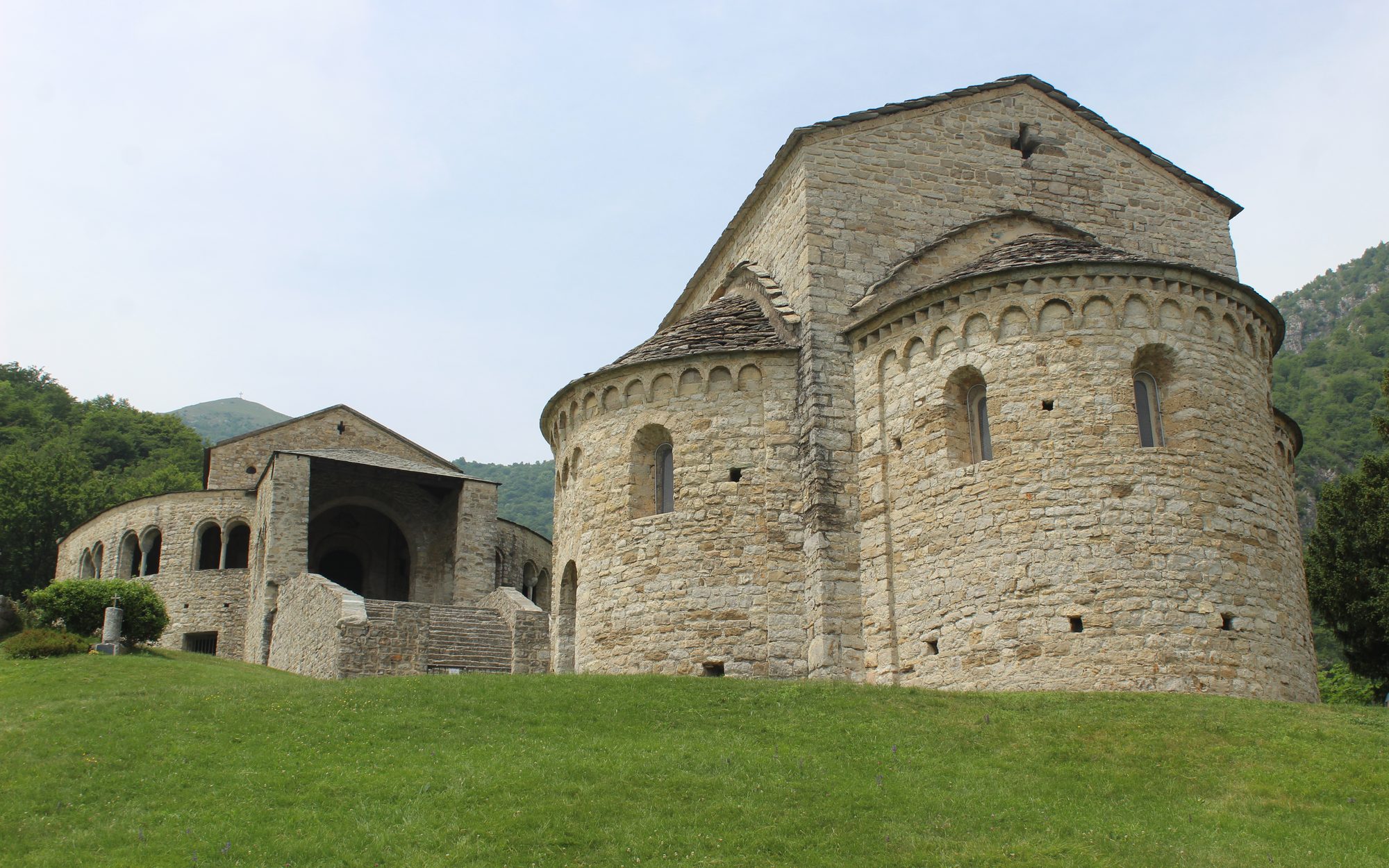
San Pietro al Monte stands at about 650 metres on the slope of the Cornizzolo, above Civate, and is reached only on foot in about an hour. It is a single-nave Romanesque basilica with two opposing apses, with a cycle of frescoes and stuccoes inspired by the Apocalypse, a crypt and, beside it, the oratory of San Benedetto. Since 2016 it has been on UNESCO’s tentative list, as part of the serial site of early medieval Benedictine settlements in Italy.
History
Tradition attributes the foundation to the Lombard king Desiderius, who is said to have thanked God for the restoration of his son Adelchi’s eyesight beside a spring held to be miraculous, still close to the church. The regional record, however, recalls that the scholar Giovanni Spinelli has contested this legendary origin and proposed that the monastery of Civate arose in the 9th century, at the initiative of the Archbishop of Milan Angilbert II (824-860) and of two Frankish monks, Abbot Leudegarius and Hildemar. A list of 35 monks of Civate, dated 845, counts eleven priests, six deacons and two subdeacons; in those years Hildemar dictated here his commentary on the Rule of Saint Benedict. Angilbert is also said to have played a role in the transfer to Civate of the body of the martyr Calocerus from Albenga.
San Pietro al Monte was not the monastery’s church, which stood on the plain with San Calocero, but a sanctuary: it was built in the second half of the 11th century over the relics of the apostles Peter and Paul, and remained one body with the monastery below. Until 941 the documents give the monastery as dedicated to Saint Peter, from 1018 the title passes to San Calocero: during the 11th century the two titles “swapped”. The altar is at the west and the route of penitent pilgrims entered from the east along the nave, with gates preventing access to the altar and choir area. In 1162 the monastery was involved in the events of Barbarossa’s descent; between the 13th and 14th centuries it declined and in 1484 became a commend. In 1555 some Olivetan monks arrived, driven out in 1798 with the suppression decided by the Cisalpine Republic, and the complex was abandoned. Since 1975 it has been looked after by the Associazione Amici di San Pietro al Monte, founded in Civate by volunteers and Don Vincenzo Gatti, who for more than fifty years coordinated the restorations.
What to see
The basilica is of stone, with hanging arches and pilaster strips in the taste of the Comacine masters. You climb to the door by a stairway that rests on the narthex built around the eastern apse, with two chapels either side of the atrium. Above the portal Christ hands the keys to Peter and the book of his word to Paul, in an early Christian scheme; the right-hand chapel, dedicated to the earthly Church, shows Christ with saints, the left-hand one, of the heavenly Church, Christ adored by hosts of angels. In the large lunette above the entrance a great fresco shows the Apocalypse vision with the Woman clothed with the sun and the defeat of the dragon.
The nave is a single rectangular hall, almost bare, with ancient fragments and votive frescoes of later periods. The centre is the ciborium, similar to that of Sant’Ambrogio in Milan: it rests on round arches and has four pointed gables, with stucco high reliefs telling episodes from the life of Jesus; above the capitals are the symbols of the Evangelists and in the small dome the triumphant Lamb with eighteen saints. By the north stairs in the middle of the nave you go down to the crypt, with three naves separated by six columns in two rows, decorated mostly in stucco and with a small masonry altar. Frescoes and stuccoes date from the third quarter of the 11th century to the early 12th, and several painters still tied to the Ottonian tradition worked on them; the art historian Yves Christe stressed its iconographic uniqueness and doctrinal depth, and scholars do not agree on the number and origin of the artists. Beside it is the oratory of San Benedetto, a three-apse building of the late 11th century with 12th-century frescoes (Wikipedia).
The climb and opening hours
You arrive only on foot, and for the association that looks after the basilica hiking boots or shoes are needed. The main path (10) starts from the locality Pozzo or from the Valle dell’Oro and has about 350 metres of ascent in 60 minutes; paths 11 and 7 go via Linate, with about 300 metres in 60 minutes; the Tre Casott loop starts from the Valle dell’Oro and takes 90 minutes with about 400 metres of ascent. For satnav it is best to set one of the car parks the association lists (such as via del Rii) or Civate, never the basilica, because Google Maps directions do not lead to the right path.
According to the association’s site, from March to October the basilica is open on Saturday and Sunday from 10 to 12.30 and from 14 to 16, with guided visits from 10.30 (Saturday) or 11.30 (Sunday) to 12.30 and from 14 to 16. From November to February on Sundays the hours are 10-12.30 and 14-15, and on Saturdays you can visit only by booking. From Tuesday to Friday you can go only by booking, within what the volunteers can manage; it is closed on Mondays. It stays open on Epiphany, 25 April, Easter Monday, 1 May, Ferragosto and Saint Stephen’s day. The guided visit is not charged for and is led by volunteers; free offerings fund restoration. On weekdays you book by phone or email by noon the day before, at weekends on the association’s site until midnight the day before; groups of more than twenty book by phone (+39 346 306 6590). The undated in-Lombardia page gives slightly different hours (Sunday 10-12 and 13-16).
At the foot of the mountain, in Civate’s centre, is the abbey’s other church, San Calocero, whose fresco cycle is linked to that of San Pietro.
Sources
- Amici di San Pietro al Monte, official site: hours, how to get there, guided visit
- Lombardia Beni Culturali, Abbazia di Civate, complesso (record LMD80-00993)
- Lombardia Beni Culturali, Chiesa di S. Pietro al Monte (record LC120-00064)
- LeccoToday, L’arte romanica nel cuore di Civate: la Basilica di San Pietro al Monte (24/5/2023)
- in-Lombardia, Basilica of San Pietro al Monte
- Wikipedia, Abbazia di San Pietro al Monte entry.