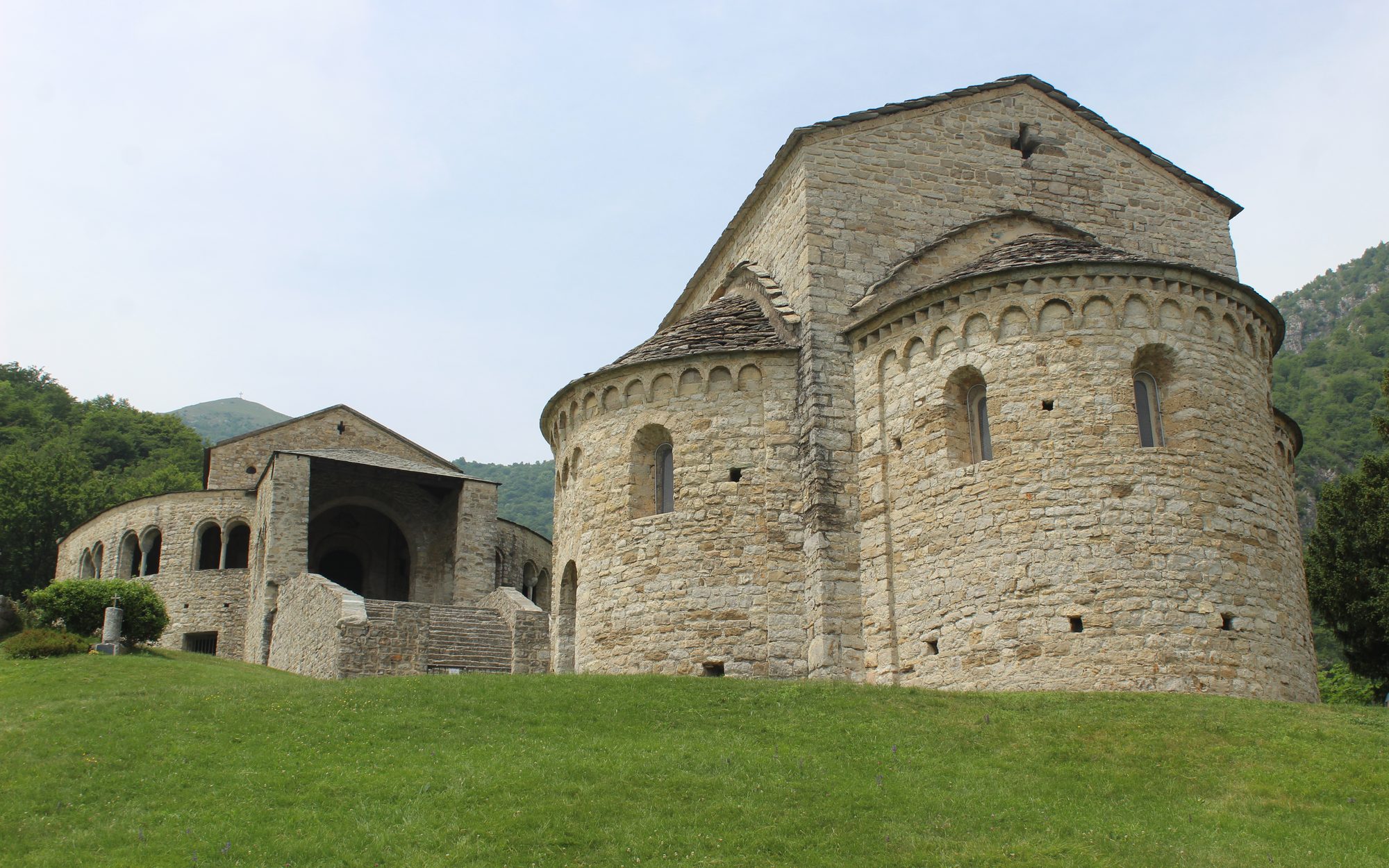
San Calocero, in the old centre of Civate, is the valley-level church of the ancient Benedictine abbey of which San Pietro al Monte is also part: it has a Romanesque crypt, an Old Testament fresco cycle hidden for centuries under the Baroque vault and remains of an eleventh-century cloister.
History
The church’s origins seem to go back to the ninth century, when the bishop of Milan Angilberto II (824-859) had the relics of the martyr Calocero, from Albenga, brought to Civate; the church then acquired the title of San Calocero, which is documented only from 1018. At the start of the eleventh century the building is thought to have been restructured, also thanks to the revival of the saint’s cult promoted by Archbishop Ariberto da Intimiano.
Of the eleventh-century cloister traces remain on the east side: a mullioned window of the chapter house and, on the upper floor, a series of single-light windows of the dormitory. In 1556, when the Olivetans had succeeded the Benedictines, the present cloister portico, with arcades and loggias, was built. The monastic complex was suppressed in 1798, then bought by private owners, among them the Nava family who turned it into a silk mill; in 1931 it was bought back by don Edoardo Gilardi, who made it a rest home for the blind. Today the complex houses a rest home for the elderly.
What you can see
The original Romanesque basilica had three apsed naves and a trussed roof. In the Baroque period the vault of the nave was built, which hid the upper part of a medieval, fragmentary cycle of frescoes with Old Testament stories: it is visible again today thanks to a route that allows access, from outside, directly to the attic. The cycle and the crypt, with three naves and a single apse, divided by granite pillars, belong to the Romanesque phase.
The frescoes show the close link with San Pietro al Monte: the last episode of the San Calocero cycle, Samson carrying the gates of Gaza to Mount Hebron, foreshadows both the Resurrection of Christ and the opening of the gates of paradise that the Heavenly Jerusalem frescoed in the entrance of the mountain basilica holds out to pilgrims bound for the Cornizzolo.
The facade, with stepped gables, decorated with small arches under the eaves and preceded by a porch with three single-light windows, underwent heavy restoration in 1937.
Practical information
We did not find opening hours, or arrangements for access to the attic and the crypt, on an up-to-date official source: it is best to ask the parish. The complex still houses a rest home.