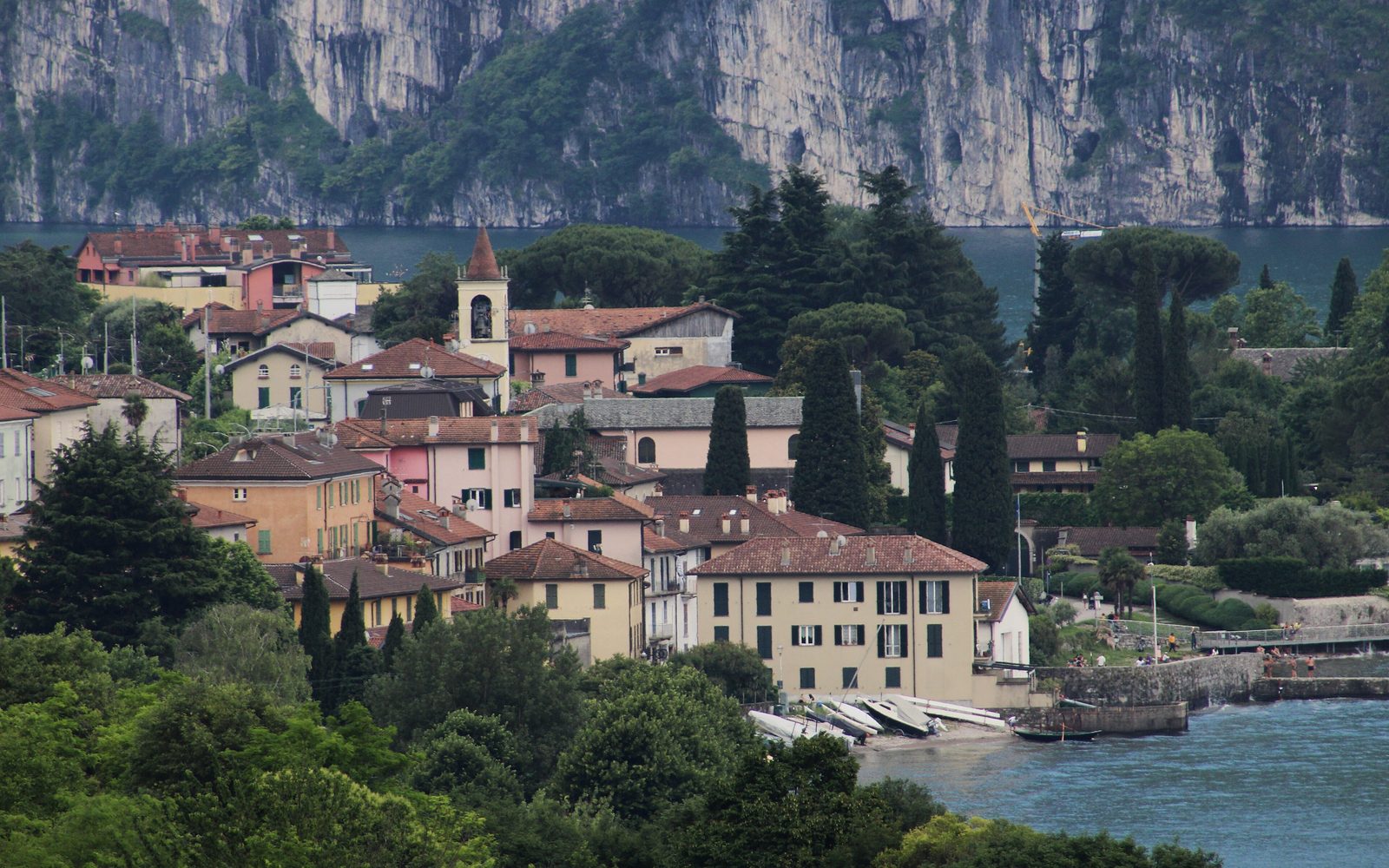
The parish church of San Lorenzo faces the lakefront of Abbadia Lariana, a few steps from the water, where for centuries the Benedictine abbey of San Pietro and then a priory of the Servites stood. Inside are a 17th-century wooden altar, two large Augustinian canvases and the frescoes Luigi Tagliaferri painted in 1915.
History
From the early Middle Ages the place had an abbey. A tradition, taken up by Wikipedia with a reference to a Lombardia Beni Culturali record, has the monastery of San Pietro founded between 770 and 772 by the Lombard king Desiderius, on an earlier cell of San Pietro in Ciel d’Oro in Pavia; the Pro Loco of the eastern Lario writes more cautiously that it is believed to have been founded by Desiderius. Around the 12th century the monastery lost importance and fell into ruin, a fate that historians, such as Tatti cited by the Pro Loco, attribute to age, but which the lake’s overflows may have hastened.
In the 13th century the Servants of Mary rebuilt the church and dedicated it to Saints Vincent and Anastasius. The parish chronicle of don Grisoni reports the tradition that it was Philip Benizi, the order’s general, who set the monastery on its feet again, passing through and finding the inhabitants abandoned. The church was small, with a single nave divided into three bays with cross vaults, a rectangular presbytery and a low roof of chestnut beams, as shown in an 18th-century drawing in the parish archive. In 1788 the friars moved to Como, to the convent of San Gerolamo, sold the small convent to the Bianchi family and handed the church to the parish, because it was larger and in better condition than the church of San Lorenzo, which stood in the place now called Chiesa rotta. The title thus passed from Vincent and Anastasius to Lawrence, and the Baroque wooden altar, the crucifix, the Madonna della Cintura and the altar of Saint Apollonia arrived here.
With the growth of the population the church became too small. The works, to a design by the engineer Giovanni Maria Stoppani, added two aisles, raised walls and pillars, rebuilt the vault and the façade and changed the presbytery with a semicircular apse. The sources are divided on the year: 1887 for Wikipedia and for the diocesan record (BeWeB), 1888 for the parish website, for the Pro Loco and for a local site. As there was no sacristy, a stretch of cellar donated by Angelo Lafranconi, who had become owner of the small convent, was used. The two side aisles are still partly hidden from the celebrant by the four large pillars that hold up the roof.
The tiled roof did not last long: water seeping in ruined the decorations, which the local decorator Oreste Broggi touched up in the 1960s. In 1980 the roof was redone in Valmalenco slate, and a wider restoration, at the start of the 2000s, repaired the damage. On 6 September 2015 the new churchyard was inaugurated, and archaeological finds emerged during the works; the parish website recalls that, near the lake, it had become a free car park in the summer months.
What to see
The façade, pink, has three openings with round windows above, stone cornices and a mixtilinear crowning, with the profiles in sandstone. Inside, the central nave has a barrel vault, and the windows of the side aisles are semicircular.
The frescoes are by Luigi Tagliaferri, a painter of Valsassina origin raised at Mandello in a family of decorators, who worked here in 1915. At the centre of the vault is the glory of Saint Lawrence, dressed as a deacon, with the palm of martyrdom, carried to heaven by angels; at his feet the gridiron on which he was burned. In the transverse bands between the pillars the twelve apostles appear in medallions; above the organ, four putti hold the scroll «Laudate Deo in cordis et organo». In the apse conch is the Apocalypse with the glory of the Lamb: on the left the saints, on the right the peoples converted by the missionaries.
The high altar is a Baroque wooden monument of the 17th century, with a ciborium 3.20 metres high, whose restoration the parish presented in February 2018. At its sides are two paintings by the painter Buzzoni with the life of Saint Lawrence. Beside the entrance door stand two large 17th-century canvases in the Augustinian tradition, by an unknown hand, perhaps from Como or Milan. The more important, in the right aisle and here only since 1915, measures 190 by 262 centimetres and shows Saint Augustine in bishop’s vestments, kneeling, receiving the holy belt from the Virgin with the Child, between Saint Monica and Saint Dominic. The canvases are thought to be tied to the feast of the Madonna della Cintura, when a 17th-century statue was carried in procession along the shore; even today on the first Sunday of September a statue of the Madonna and Child is displayed on a throne and carried in procession.
The wooden crucifix comes from the old church. Tradition called it 15th or 16th century, but the restoration finished in May 2009 showed it was made in the 19th century, perhaps copying an older example now lost. The baptismal font is of 1989, by the sculptor Fulvio Simoncini: a hexagonal shaft holds a circular basin, with six panels on the history of salvation.
Practical information
- The church is at via Lungo Lago 4, in Abbadia Lariana; the parish answers on 0341 735482 and publishes Mass times on its website.
- Beside the church the cloister of the ancient abbey can still be seen, and in the park of Chiesa rotta some remains of the first parish church dedicated to San Lorenzo.
- With a short detour from stage 02 of the Sentiero del Viandante one goes down to the church. In the same village is the Civico Museo Setificio Monti; see also the town of Abbadia Lariana.
Sources
- Parrocchia di Abbadia Lariana, Chiesa Parrocchiale di San Lorenzo
- Pro Loco Lario orientale, Abbadia Lariana: La Chiesa di San Lorenzo (2012, from Abbadia Oggi, 1987)
- Lombardia Cristiana (BeWeB), Chiesa di San Lorenzo (Abbadia Lariana)
- Como e il suo lago, La Chiesa di San Lorenzo a Abbadia Lariana
- Le Vie del Viandante, Abbadia Lariana - Chiesa di San Lorenzo
- Wikipedia, entry Chiesa di San Lorenzo (Abbadia Lariana).