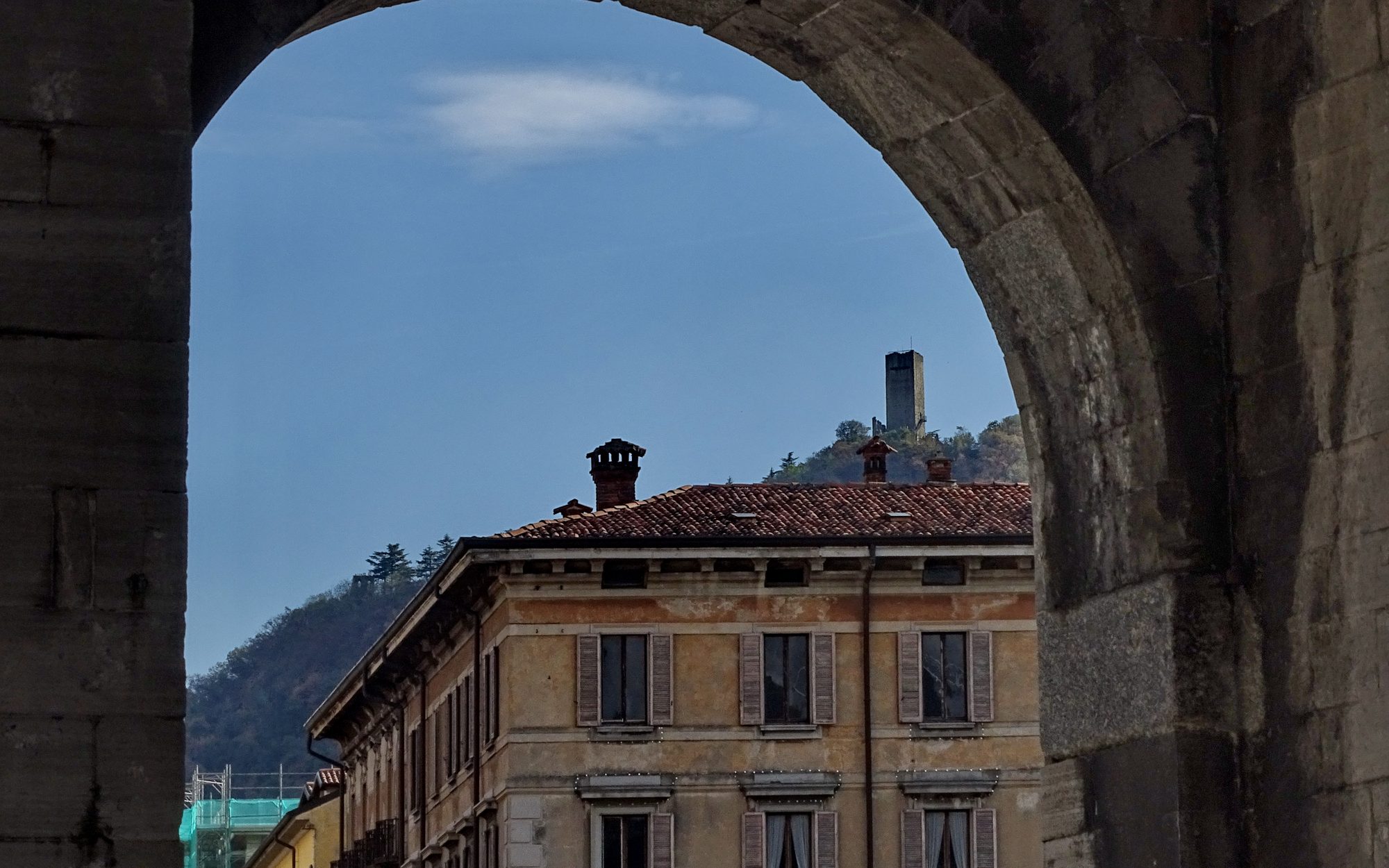
Porta Torre is the main gate of the walled city of Como, halfway along the south side of the walls, and is regarded as its symbol. Since 1192 it has watched over the road to Milan from piazza Vittoria; since 2022 the passage under the arch has been closed by barriers, after a stone came loose from the top.
History
At the end of the ten-year war, in 1127, the Milanese pulled down the Roman walls of Como. The city rebuilt them with the consent of Frederick Barbarossa, who came down to Italy against Milan in 1154, and for decades strengthened above all the south side, the one facing its adversaries. The Porta Milanese opened here: in 1192 the podestà Uberto turned it into a monumental structure. The Società Archeologica Comense and the regional catalogue call him Uberto da Pavia, Wikipedia Uberto de’ Olevano. The foundations rest on a system of piles, and the bulk was also meant to show Milan the strength of Como.
In the sixteenth century the gate received a large ravelin with gun openings at the top, a semicircular bastion of which traces remain in the nearby pedestrian underpass. The Società Archeologica, which is studying it together with the Comune, dates it to 1504. The bastion was pulled down in the early nineteenth century, in the Napoleonic period.
What it looks like
It is a square-based tower, about 40 metres high according to Lombardia Beni Culturali and UPEL; Wikipedia, relying on the Touring Club, gives 34 metres. The outer side, facing Milan, is massive, in stone, with two archways. The side facing the city is livelier: four rows of two round-arched windows, one for each of the four interior floors, in wood and now lost, and below them a large arch with a ring of alternating light and dark ashlars. The eight arches of the floors are off-axis with the large one; Wikipedia explains this by the access stair, which climbed along the side.
Current state
In the spring of 2022 a stone came loose from the top and fell without hitting anyone (La Provincia di Como, 3 April 2025). Since then the passage under the arch has been forbidden and the monument is fenced off with barriers and red building-site netting. The sources differ on the date: EspansioneTv writes April 2022, while the Svolta Civica motion reported by ComoZero gives 8 August 2022.
The aim was to remove the barriers in 2024, then in the spring of 2025. On 11 September 2026 EspansioneTv writes that little or nothing has changed; the mayor, in early June, had said the works will be done but that «we are late». In 2025 the president of the Società Archeologica explained that with the Comune they were monitoring the ravelin in the underpass, with no date for the end of the analysis. The same motion asks that Torre Gattoni, Torre di San Vitale and this gate, the three great towers of the walls, be made safe before the end of the mandate.
What to see
Today the tower is looked at from outside, from piazza Vittoria, where the outer facade can be appreciated. There is no date for reopening the passage. In the basement of the nearby Liceo Volta there are ruins of the Roman walls and of a gate, called Porta Pretoria (UPEL, Wikipedia): we have not found a recent source on visits.
Practical information
- Address: piazza Vittoria, at the start of largo Gianfranco Miglio, on the south side of the walled city.
- The outside can be seen freely; the tower and the passage under the arch are not accessible and there are no opening hours.
- Torre Gattoni is about 280 metres away, according to Camminacittà. The gate is the second stop of the itinerary Medieval Como.
- News about works and reopenings changes: check the local sources before planning the visit.
Sources
- Lombardia Beni Culturali, Mura medioevali di Como
- Società Archeologica Comense, Le mura di Como, chapter 2 and chapter 1
- UPEL Italia, Mura medievali (29/3/2022)
- La Provincia di Como, «Anche a Porta Torre transenne da tre anni» (3/4/2025)
- EspansioneTv, Mura e torri di Como, mozione di Svolta Civica (11/9/2026)
- ComoZero, la situazione delle torri medievali (September 2026)
- Wikipedia, entry Porta Torre (Como).