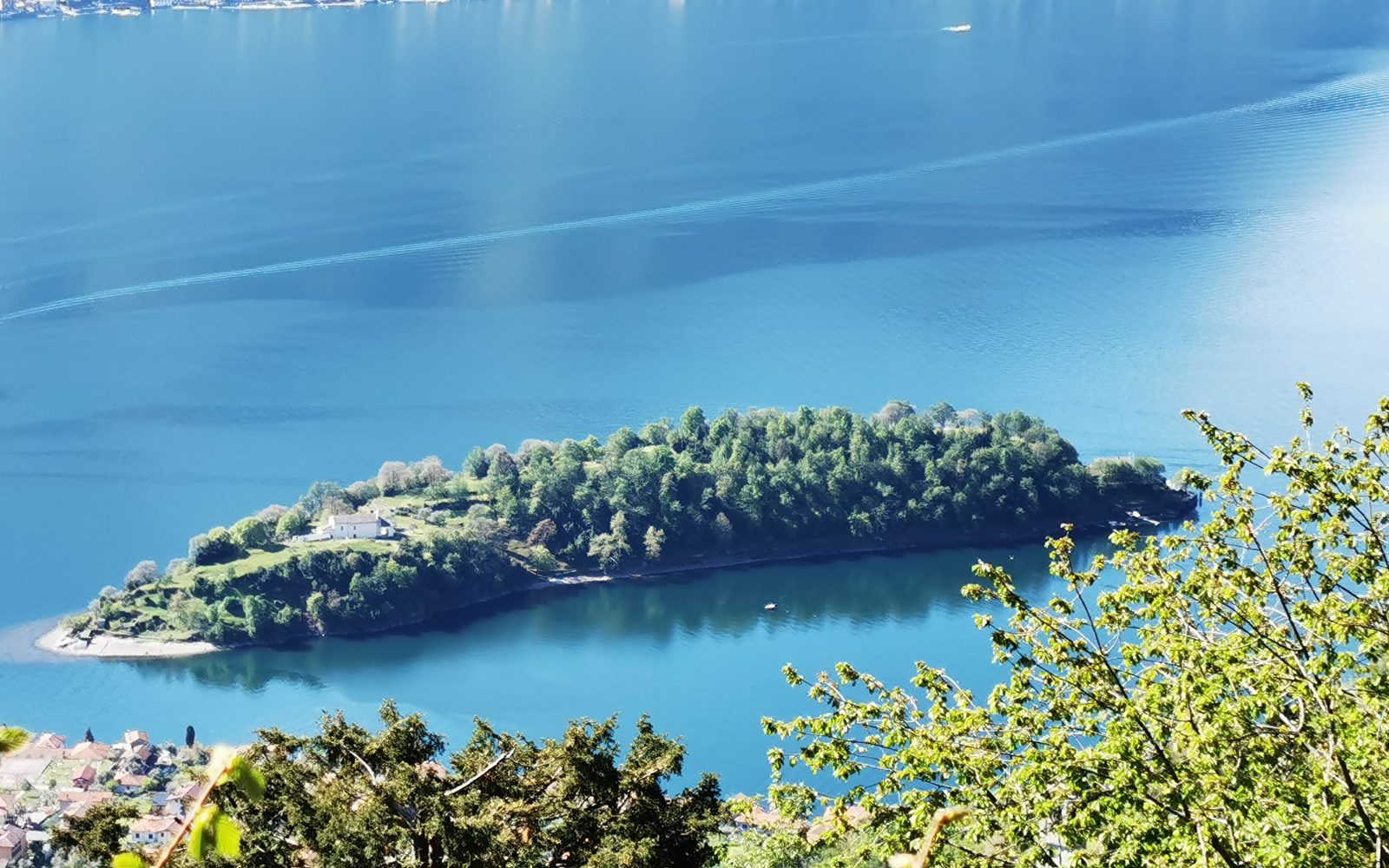
The artists’ houses are three rationalist buildings in stone and wood that the architect Pietro Lingeri built on the Isola Comacina between the 1930s and 1940, to host artists from all over the world in a place of quiet and contact with nature. They are seen from the «Sentiero degli artisti»; the interior is not visited, except on guided visits, and the houses may be occupied.
History
The island passed, by inheritance, to King Albert I of Belgium, who donated it to the Italian State; the State entrusted it to the Brera Academy with the aim of building an artists’ village and a hotel, according to Wikipedia and the Associazione Culturale Isola Comacina. The site of the Comune di Tremezzina says that the original project dates back to 1920 and that the houses were conceived to host Italian and Belgian artists. The hotel was never built; the inn was, in 1964, according to Wikipedia.
The sources do not agree on the year of the houses: Camminacittà, in stage 5, writes that Lingeri built them in 1933, and in the list of points of interest dates them from 1937 to 1940; for the Associazione Culturale Isola Comacina and for Wikipedia they are from 1939; for the FAI, from 1940, and the Comune di Tremezzina’s site says both 1940 and «the 1930s»; Arci Ecoinformazioni speaks of the late 1930s.
What to see
For the Comune di Tremezzina they are a rationalist architecture that rereads, with modernist touches, the vernacular building ways of the Lario. The FAI makes them refer, as a model, to Le Corbusier’s holiday house, and observes that functionality and essentiality go with local materials, Moltrasio stone and wood, which fit the three buildings into the landscape of the island. Sacri Monti calls them the island’s artists’ colony, three rationalist houses designed by Lingeri for the Brera Academy. Lingeri was from Tremezzo, Camminacittà notes.
The «Sentiero degli artisti» starts from the complex of Santi Faustino e Giovita, descends with twelve stone steps and, after some twenty metres on the level, reaches the first house; fifty metres further on is the second, and a little lower down, on the right, the third. Those who wish can continue along the eastern shore of the island, with a fine view of the Punta del Balbianello at Lenno, as far as the remains of the basilica of Sant’Eufemia. In 2013 Arci Ecoinformazioni recalled a careful restoration of the three houses.
On the route
The houses are the fifth stage of the Camminacittà route of Ossuccio and the Isola Comacina, «Il paradiso degli artisti». The full walk is in the Ossuccio and Isola Comacina itinerary.
Practical information
- Camminacittà specifies that the interior can be seen only on organised guided visits and that the houses are, at times, occupied. We have not found on an official source the dates or booking of the guided visits.
- The path is dirt and begins with twelve stone steps downhill (Camminacittà).
- The island is a paid archaeological park: the site of the Comune di Tremezzina, read in October 2026, says it is open every day from 10 to 18, between May and the end of October.
- Nearby: the church of San Giovanni Battista and the Isola Comacina.
Sources
- Camminacittà, Ossuccio path 1, stage 5 and points of interest
- Isola Comacina, official site of the Comune di Tremezzina
- FAI, Isola Comacina: case degli artisti, chiesa di S. Giovanni, resti della basilica di S. Eufemia
- Associazione Culturale Isola Comacina, L’Isola Comacina
- Sacri Monti, Antiquarium Museum Collection and Isola Comacina
- Arci Ecoinformazioni, A Ossuccio un Antiquarium per un nuovo turismo (31 May 2013)
- Wikipedia, article on the Isola Comacina.
- OpenStreetMap, for the position of the three houses.