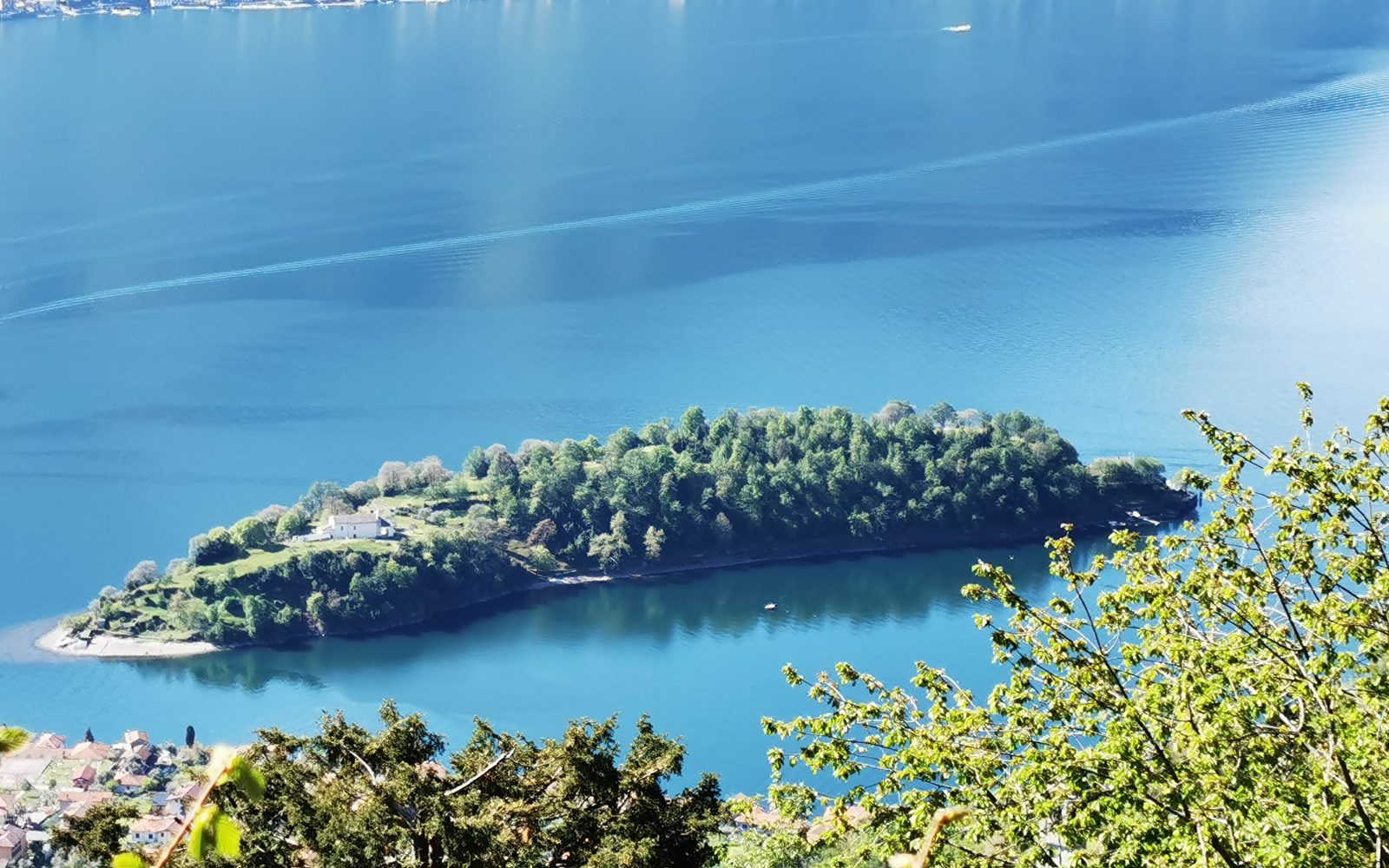
The church of San Giovanni Battista is the only church that exists today on the Isola Comacina. It stands on a spur of rock above the ruins of the basilica of Sant’Eufemia, white, with a single nave and a portico, and was built on the remains of older buildings. It was reconsecrated in 2009 after restoration; on the Sunday nearest 24 June it holds the festival of Saint John.
History
Camminacittà says it was built in its present form in the 17th century on the remains of older buildings; the Associazione Culturale Isola Comacina says 16th century and refers to a document of 1683, and Lombardia Beni Culturali, for the complex of the church and the remains of Sant’Eufemia, gives «before 1575». The sources, then, do not agree on when it was erected.
Beneath and beside the church the excavations have found a long history. The Associazione Culturale Isola Comacina recalls the remains of a Roman building with columns, perhaps a villa or a temple. The FAI lists among the finds kept by the church the base of a late-antique tower that served as a bell tower, the baptistery with a palaeo-Christian mosaic and the remains of the 11th-century basilica of Sant’Eufemia. Wikipedia writes that the building also incorporates part of the foundations of a Romanesque chapel.
After the destruction of the island in 1169, according to Camminacittà and the site of the Comune di Tremezzina, the island stayed almost deserted for centuries. According to Wikipedia the little church gives the island the name San Giuann, beside that of Castell.
What to see
Outside, a single white nave with a portico; inside, Camminacittà points out the scagliola altar frontal with the effigy of the saint. The reconsecration was in 2009, after the most recent restoration, and since then the church has been back in worship.
A few steps away, about fifteen metres along the left side of the church, is the fenced area of the two-apsed baptistery: a building of the 5th century, remodelled between the 8th and 9th centuries, when the two apses were added and the decoration redone: mosaics and frescoes remain. You can see the remains of the octagonal baptismal font in cocciopesto faced with marble slabs. Camminacittà judges it significant because it shows how much the island counted as the cradle of Christianity in the Como area.
The festival
On the Sunday closest to 24 June, the feast of the saint, Mass is celebrated there with great solemnity, as part of a festival that Camminacittà counts among the oldest and most significant on the Lario. According to Wikipedia the festival includes a procession of boats and a fireworks show on the lake. On the Saturday and Sunday of the week of 24 June, the same entry adds, the lake is lit by «lumaghitt», floating lights, to recall the destruction of 1169. The Associazione Culturale Isola Comacina derives the late-June festival from a document of 1683.
On the route
The church is at the centre of the third stage of the Camminacittà route of Ossuccio and the Isola Comacina, after the Casa Torre. The full walk is in the Ossuccio and Isola Comacina itinerary.
Practical information
- The island is a paid archaeological park: the site of the Comune di Tremezzina, read in October 2026, says it is open every day from 10 to 18, between May and the end of October.
- We have not found opening hours for the church or Mass times outside the festival.
- Camminacittà notes dirt paths, uneven steps and stretches with no protection at the edge.
- Nearby: the remains of the basilica of Sant’Eufemia and the artists’ houses.
Sources
- Camminacittà, Ossuccio path 1, stage 3
- Lombardia Beni Culturali, Chiesa di S. Giovanni e resti di S. Eufemia (record CO250-00047)
- FAI, Isola Comacina: case degli artisti, chiesa di S. Giovanni, resti della basilica di S. Eufemia
- Associazione Culturale Isola Comacina, L’Isola Comacina
- Isola Comacina, official site of the Comune di Tremezzina
- Wikipedia, article on the Isola Comacina.
- OpenStreetMap, for the position.