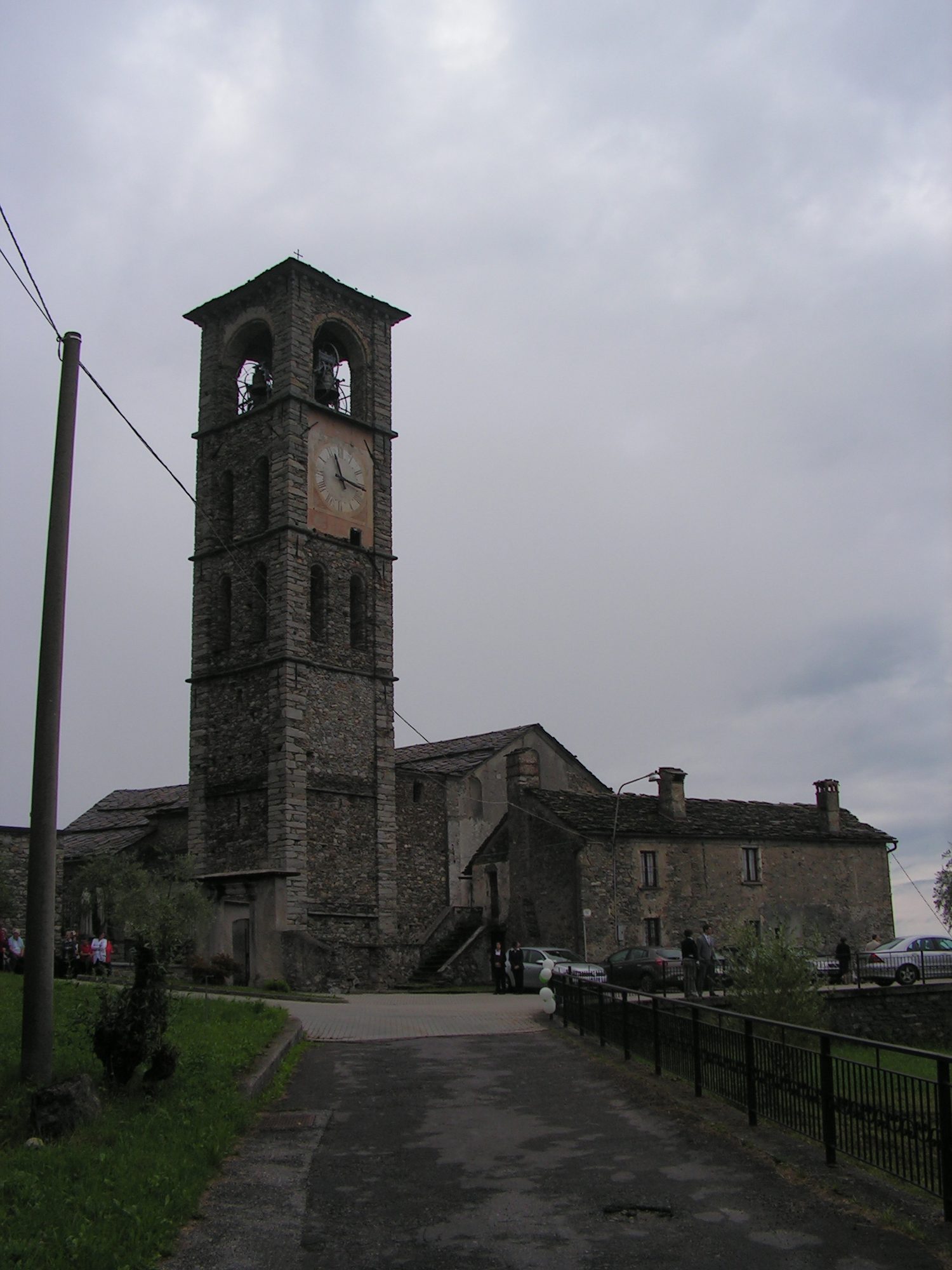
Tied to the legend of the landslide that buried the old settlement of Ganda, the Church of San Pietro in Costa was for centuries the only parish church of Dosso del Liro, today standing alone on a hillside among chestnut trees, reachable only on foot.
History
Local tradition holds that in ancient times Dosso del Liro did not stand on its present slope, but further uphill, near today’s Pozzanega locality, in a settlement called Ganda. The parish church of the time was San Pietro in Costa itself, dependent on the Collegiata of Gravedona, and the parishioners of Ganda had to walk about an hour to reach it. One day of relentless rain, as the villagers set off for Mass, a local woman, an herbalist suspected of witchcraft, refused to go with them, saying she would not move “even if Ganda, this very morning, fell into the river.” On their way back from the service, the villagers found their village swept away by a landslide, which had diverted the course of the valley’s streams.
The church is first recorded in 1328, though its apse, still Romanesque in layout, suggests an earlier foundation; the building was probably rebuilt in the second half of the 15th century. In 1558 Bishop Giovanni Antonio Volpi detached it from the pieve of Gravedona, and in 1578 the apostolic visitor Francesco Bonomi ordered the façade painted red and the image of the patron saint added. San Pietro in Costa remained Dosso del Liro’s only parish church until the 17th century — at the end of the 16th century, Bishop Ninguarda’s pastoral visit counted 620 parishioners here — when, in 1627, Bishop Archinti authorised moving pastoral care to a new oratory in the village itself, closer to people’s homes: parish status passed to the new church of Santa Maria, today the Santissima Annunziata.
What to see
The presbytery holds a fresco cycle completed in December 1532, commissioned by parish priest Vincenzo Curti and painted by Giovanni Antonio De Lagaia: God the Father in glory, the Announcing Angel, the Twelve Apostles and Christ in glory among the Evangelists, together with the Doctors of the Church. The nave holds further 16th-century frescoes depicting the Baptism of Christ, the Madonna and Child, Saint Roch and other saints. The church also preserves a 1577 votive canvas, donated by emigrants from Dosso del Liro who survived the plague in Palermo, and a 16th-century wooden altar.
Getting there
The church can no longer be reached by car: it stands outside the village, on a hillside surrounded by chestnut trees, and can only be reached on foot along a woodland path — it was this very distance from the village that led, in the 17th century, to its abandonment as the parish seat.
Practical information
- Open to the public every third Sunday of the month, from 3pm to 5:30pm, together with the nearby Santissima Annunziata, as part of the “Chiese Aperte” (Open Churches) event in Alto Lario.