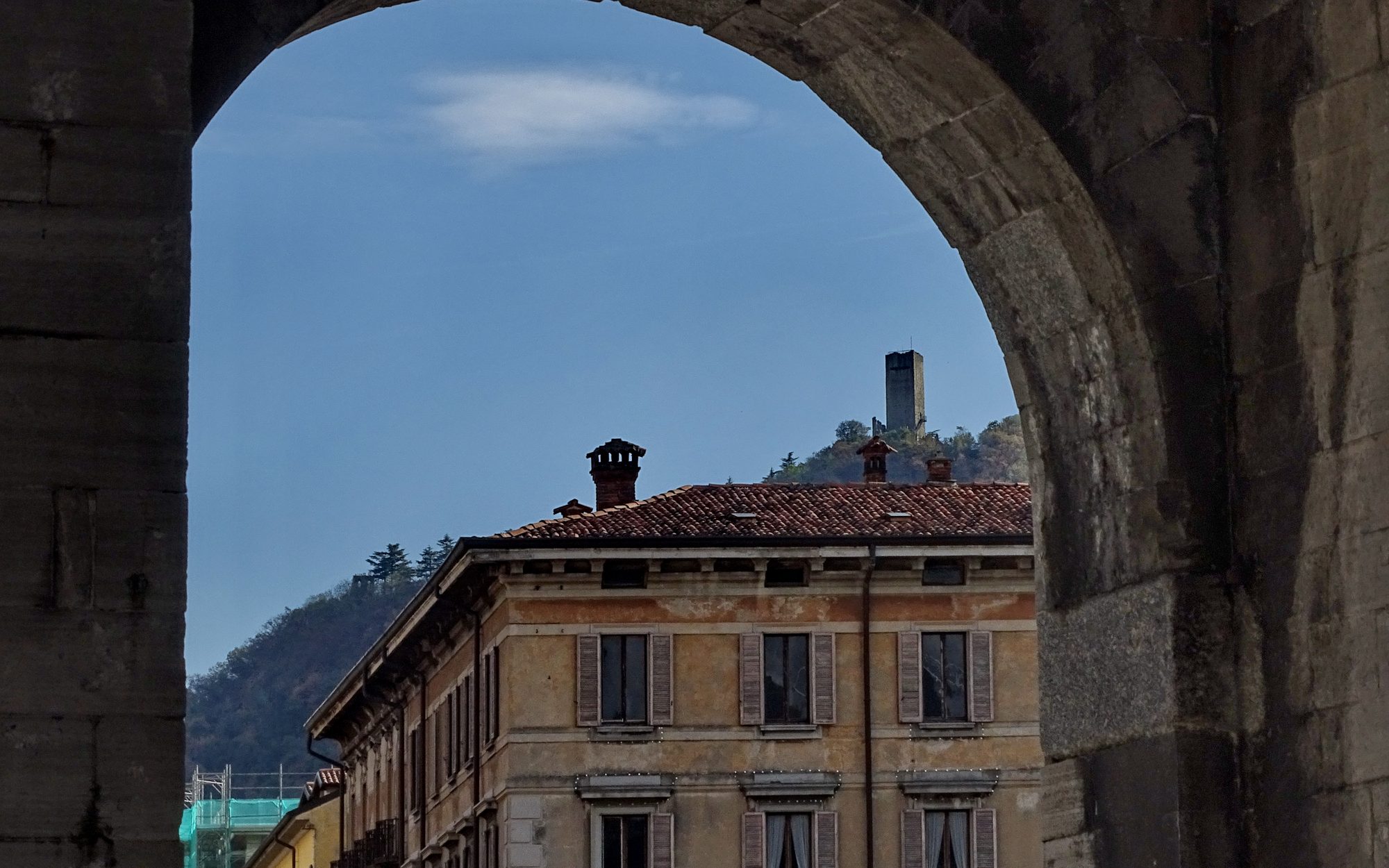
The medieval walls of Como surround the old town on three sides and follow, with a slightly wider perimeter, the layout of the Roman city. The south side is the only one still intact and has the three great towers; the towers are fenced off, however, and the rest of the circuit is done along the avenues.
History in brief
The Milanese pulled down the Roman walls in 1127, at the end of the ten-year war. Como had them rebuilt with the consent of Frederick Barbarossa: the works, begun in 1158, went on until 1192 and strengthened above all the south side, facing Milan, while the empire lay to the north. The walls were high, crenellated and protected by a ditch; at the time no city building rose above them, because the Cathedral, the Broletto and the tower-houses did not yet exist (Società Archeologica Comense).
In the last twenty years of the thirteenth century the Rusca family built the Castello della Torre Rotonda (1284-1285) on the eastern side, and the walls were taken down to the lake. In the fourteenth century the Visconti strengthened Porta Torre and Porta Nuova and made the castle the hub of the Cittadella Viscontea. In the sixteenth century the French and the Spanish added bastions and ravelins; in 1783 the walls went from the military treasury to the Comune, which in turn transferred them to private owners, and the ditch was filled in and turned into a tree-lined avenue. On 20 March 1848 volunteers from Como took the walls and gates during the uprising against the Austrians. In 1975 it was decided to avoid any further radical works.
How to recognise them
The stones help. The Roman walls are in Moltrasio stone with wider, elongated ashlars; the medieval ones use the same stone but in smaller blocks. The plinth of both lies more than two metres below the present street level. Where the two walls run close together, as at the crossing with via Cinque Giornate, they can be seen side by side.
South side: the only complete one
It starts from Torre Gattoni, then follows viale Cattaneo. Here the walls still show the scarp that strengthened them, the sloping base, and the buttresses added for the weak ground of the filled-in ditch. Further on is Porta Torre, the symbol of the circuit, and the south-eastern corner ends in the Torre di San Vitale. From the passage of via Diaz you see the space between Roman and medieval walls, which in the late eighteenth century passed to private owners, who covered it with earth and made gardens; in one wall there is the blocked little door of a Second World War air-raid shelter.
West side: viale Varese
From the mouth of via Garibaldi, where Porta Sala stood, the Federician wall runs along viale Varese. The marks of the centuries can be read in it: the blocked openings made when the hanging gardens passed to private owners, the buttresses against the push of the terraces, the remains of the Santa Margherita forework and, on the paving of the Annunciata, the outline of the forework pulled down in the nineteenth century.
East side and castle
Past the Porta San Vitale you follow the wall in the public garden as far as the school in via Perti, where the visible remains end. A little further on stood the Castello della Torre Rotonda, which was demolished in 1811 to make room for the Teatro Sociale: a stretch of the Federician wall survives under the stage. The side on via Bertinelli was redone around 1850. The «Muro Comunale» wanted by Loterio Rusca, put up in the last years of the thirteenth century (1286-1288), still closes off the Ferrovie Nord station and keeps the blocked Porta Ferrea and Porta di Coloniola.
North side
On the lake there was no continuous curtain: the harbours were protected, more plausibly, by towers. At the corner of via Pretorio and via Rodari stands the Torre Pantera, of uncertain date: most authors consider it fourteenth-century, but the base may be older. In via Garibaldi, near the doorway of a building, you can glimpse the remains of a twelfth-century tower, made of reused Roman stones.
Current state
The mayor announced on 8 August 2023 the end of the restoration works on the walls of via Balestra. The three towers, instead, are fenced off for fear of falling stones: San Vitale since 2021, Porta Torre since 2022, Torre Gattoni still surrounded by fences, according to the Svolta Civica motion of September 2026. Part of the circuit and of the hanging gardens is private, and this, the Società Archeologica explains, makes it hard to open them to the public, in particular on the via Volta stretch.
Practical information
- The whole circuit is done on foot along viale Varese, viale Cattaneo, viale Lecco and the inner streets; there is no signposted route and no opening hours.
- From outside you see the towers; the passages under Porta Torre are closed.
- In the basement of the Liceo Volta there are ruins of the Roman walls and of a gate, but we have not found a recent source on visits.
- The walls are the first stop of the itinerary Medieval Como.
Sources
- Lombardia Beni Culturali, Mura medioevali di Como
- Società Archeologica Comense, Le mura di Como, chapter 1 and chapter 2
- UPEL Italia, Mura medievali (29/3/2022)
- La Provincia di Como, «Anche a Porta Torre transenne da tre anni» (3/4/2025)
- ComoZero, la situazione delle torri medievali (2026)
- EspansioneTv, Mura e torri di Como, mozione di Svolta Civica (11/9/2026)
- Wikipedia, entry Mura di Como.