Como keeps a compact group of rationalist works, many of them by Giuseppe Terragni (1904-1943), and they can be covered on foot in a short time. This itinerary puts them in order, from the Casa del Fascio in piazza del Popolo to the buildings of the lakeside district, and says for each what you can actually visit: of almost all of them you see the outside, and only the Monumento ai Caduti has opening hours for the public.
The walk in brief
The Comune’s tourism portal proposes a route that starts at the Pinacoteca civica, passes through piazza del Popolo and the lakefront and ends at the Monumento ai Caduti. The Camminacittà project, which has laid out a stage-by-stage one called «Cammino della città moderna», instead makes it begin at the Asilo Sant’Elia and end at the Novocomum: about 4.6 kilometres and an hour and a half of walking, visits excluded, with no climbs (the overall descent is about 20 metres). Here we start from piazza del Popolo and leave the Asilo for the end, because it lies far from the rest and is open only on particular days.
| Work | Visit (status in October 2026) |
|---|---|
| Palazzo Terragni (former Casa del Fascio) | Seat of the Guardia di Finanza: seen from the square; the atrium has been seen only on guided visits organised by third parties |
| Monumento ai Caduti | Open in 2026 from 2 June to 4 November: Wednesday and Friday 10 am-1 pm, Saturday and Sunday 2-5 pm, with a ticket |
| Casa Giuliani Frigerio | Private residence: seen from the street |
| Novocomum | Lived-in building: seen from the street |
| Asilo Sant’Elia | Closed since 2019: special openings with a guided visit |
Piazza del Popolo and the Casa del Fascio
You begin with the symbol of Italian rationalism, Palazzo Terragni, the former Casa del Fascio: Terragni designed it in 1932 and it was completed in 1936 (the page explains why sources disagree on the dates). Today it houses the provincial command of the Guardia di Finanza. It is worth walking around it: the four facades are different, and from the pavement of via dei Partigiani you can touch the marble cladding and the glass-concrete.
From the stone-paved square Camminacittà describes a view that sums up almost a thousand years of history: to the west, beyond the tracks, the medieval walls, the Teatro Sociale, the apses of the Duomo, the dome of San Giacomo and the bell tower of San Provino; to the east Monte Brunate with the funicular climbing the slope. Facing the Casa del Fascio stands the former palace of the Fascist Union of Industrial Workers, by the rationalists Cesare Cattaneo and Pietro Lingeri, begun in 1938 (Giorni Rubati and Camminacittà).
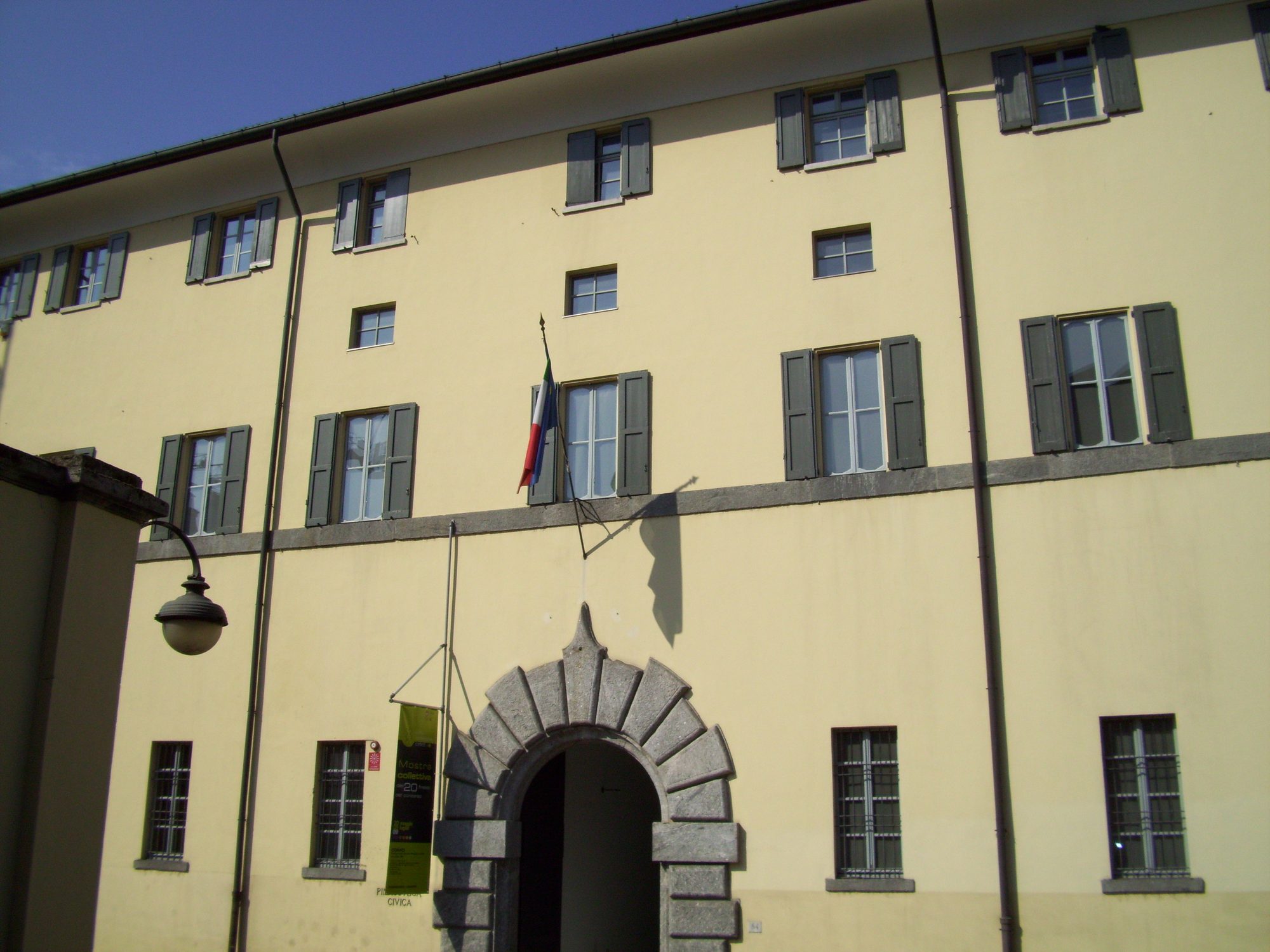
To understand the context, the Comune’s portal suggests starting from the Pinacoteca civica, where you get to know the drawings of Antonio Sant’Elia and the works of the Como abstract artists, linked to rationalist culture.
From the old town to the lake
You cross the tracks and arrive in piazza Verdi, in front of the Teatro Sociale, then follow the side of the Duomo to piazza Duomo, where next to the cathedral stands the Broletto. Rationalism reappears at the corner with via Cinque Giornate: it was the Vitrum shop, designed by Terragni in 1930 and now a clothing store (Camminacittà). The Broletto has a part in the story you meet further on: in 1930 it hosted the exhibition on Sant’Elia from which the idea of the Monumento ai Caduti was born, as the monument’s page tells.
Further on, in piazza Peretta, Camminacittà recalls the Cortesella, a district demolished after the 1937 town plan; in the 1934 competition Terragni, with other designers, had proposed renewing it with «comb-shaped» buildings with arcades. Then you go down to the Giardini a lago and viale Marconi: on the breakwater you see The Life Electric, Daniel Libeskind’s 2015 monument to Volta, about 16.5 metres high according to Camminacittà.
The Tempio Voltiano and the Monumento ai Caduti
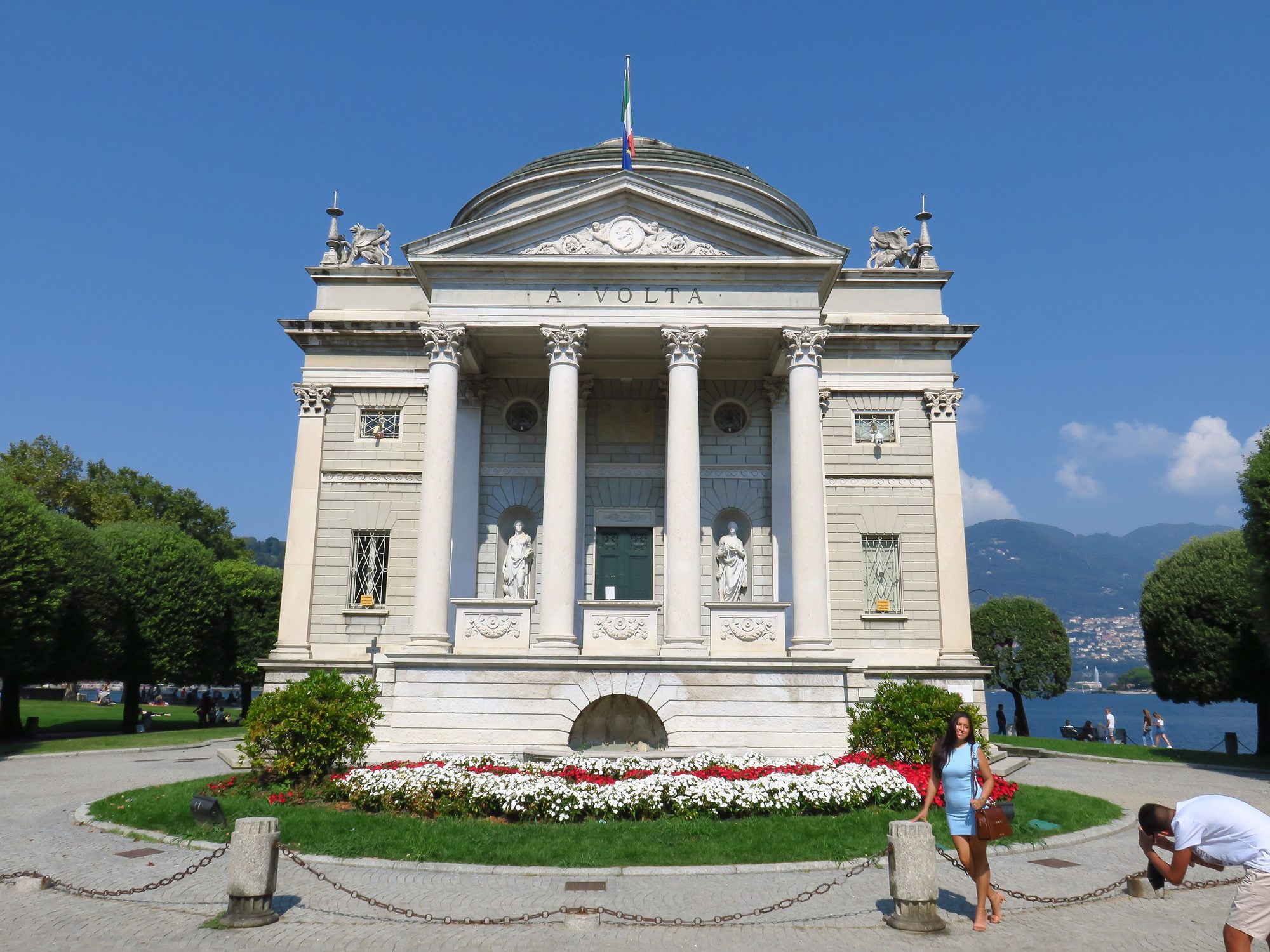
In the gardens the Tempio Voltiano, designed by Federico Frigerio and completed in 1927, stands for eclecticism in an area that Camminacittà calls the «Museo Urbano dell’Eclettismo, del Futurismo e del Razionalismo Comasco», between the stadium, the Yacht Club and the monument. Here rises the Monumento ai Caduti: a tower of 1933 by the brothers Giuseppe and Attilio Terragni, born from a drawing by the futurist Antonio Sant’Elia. Inside, according to the Comune’s portal, the shrine holds a monolith with the names of 750 fallen from Como and an internal staircase of 140 steps leads from the crypt to the top terrace, with the view over the city. In 2026 the monument can be visited with a ticket, on the days and at the times given above; the stairs are steep and narrow, and the page reports the Comune’s warnings.
The rationalist district, up to the Novocomum
From here you enter the «rationalist district» between viale Puecher and viale Sinigaglia, where between the 1920s and 1930s the lakeside strip took on new residential, sporting and commemorative functions. Along viale Puecher Camminacittà points out the seat of the Canottieri Lario (Gianni Mantero, 1930-1931), the Circolo della Vela e della Motonautica (1931-1932, by the engineer Balsamo with Attilio Terragni) and, opposite, the north side of the Giuseppe Sinigaglia stadium. A little further, in piazzale Somaini, stands the 1930-1931 Hangar by Carlo Ponci, which according to the project is unique in Italy, with the 1935 seat of the Aeroclub Como. The Comune’s portal also lists the Idroscalo of 1930.
In viale Rosselli you reach Casa Giuliani Frigerio, of 1939-1940, the last building Terragni saw built, with facades that are all different. The walk ends at the Novocomum, the apartment house of 1927-1929 nicknamed «il Transatlantico», considered one of the first modern buildings in Italy, with glazed corners and a permit obtained by showing the Comune drawings of classical facades. The Comune’s portal lists these works in a different order (first the Novocomum, then Casa Giuliani Frigerio, then the sports buildings on the lake, finally the monument): the route can be walked in either direction.
Apart: the Asilo Sant’Elia
The Asilo Sant’Elia, in via Alciato, is the nursery school that Terragni designed in 1934-1937 for a working-class district: low, U-shaped, with large windows onto the garden. It lies about 2.2 kilometres and 45 minutes on foot from piazza del Popolo, according to Camminacittà, and has been closed since 2019: in 2026 the openings with a guided visit announced were 26 February, 24 April and 6 June.
Whoever visits it on one of these days can walk the route backwards compared with this itinerary, as Camminacittà proposes. The project also lists other works on the way to the centre: the Case popolari in via Anzani, by Terragni and Alberto Sartoris (1938-1939), Lingeri’s Casa Cattaneo Alchieri in via Mentana (1936) and Casa Pedraglio, by Terragni himself (1935-1937). In Camerlata, off the route, are the monumental fountain by Cattaneo and Mario Radice (designed in 1935, built in 1962) and Terragni’s Villa per un floricoltore (1936-1937).
Practical information
- Length and times: those of Camminacittà for the Cammino della città moderna, from the Asilo Sant’Elia to the Novocomum: about 4.6 kilometres and an hour and a half on foot, visits excluded; from the Asilo to piazza del Popolo it is 2,200 metres and 45 minutes, and from there to the Novocomum another 2,400 metres and 45 minutes. The route is urban, on asphalt, porphyry and stone paving, with a maximum altitude of 225 metres. The data are from 2021-2023: roadworks and closures may change them.
- Monumento ai Caduti: calendar, hours and ticket are valid for the 2026 season (until 4 November); they are on the monument’s page and should be rechecked after that date.
- Casa del Fascio: the building is a seat of the Guardia di Finanza. In summer 2026 an association organised guided visits to the atrium; for new dates see the page and ask the organisers.
- Asilo Sant’Elia: for openings check the websites of the Comune di Como, the FAI and the MAARC; after 6 June 2026 we found no other dates on official sources.
- To reach Como, see the guide Getting to Lake Como; for piazza del Popolo Camminacittà lists Trenord’s Como Lago station, in largo Leopardi.
- The Como-Brunate funicular, which forms the backdrop to the Casa del Fascio, climbs to Brunate: times and fares are on its page.
Sources
- Oggi a Como (Comune’s tourism portal), Il Razionalismo
- Camminacittà, Como Percorso 5: il Cammino della città moderna, with stages 1 and 2
- Como City, Como razionalista: itinerario a piedi and Giorni Rubati, Como razionalista: piccolo tour sulle orme di Terragni
- Records of the works: Lombardia Beni Culturali, Asilo Sant’Elia and Casa Giuliani Frigerio; MAARC, Asilo Sant’Elia and Casa Giuliani-Frigerio, besides the sources of the pages for Palazzo Terragni, the Monumento ai Caduti and the Novocomum.